Day 3 of 14 · What's Coming
"But I Tried It..."
⏱ 6 min
📊 Beginner
This is the lesson for everyone who's tried ChatGPT, thought "meh," and moved on. If that's you — you're not wrong that your experience was underwhelming. You're wrong about what it means.
The most common reaction to AI right now is: "I tried it. It was okay. I don't see what the fuss is about." And that reaction is one of the most dangerous things you can have — because it gives you false confidence that you understand the technology.
The skill gap nobody talks about
Here's what most people did when they first tried AI: they opened ChatGPT, asked it something vague like "write me an essay about climate change," got a generic response, and concluded that AI is basically a slightly better Google.
That's like test-driving a Ferrari in a parking lot and concluding it's not that fast.
The gap between what people tried and what AI can actually do is enormous:
What people tried: "Write me a business plan."
What AI can do: "You're a business strategy consultant. I'm launching a mobile dog grooming service in Austin, TX. My startup budget is $15,000. Analyze the local market, identify my top 3 competitor advantages, and create a 90-day launch plan with weekly milestones and projected revenue."
What people tried: "Help me with my resume."
What AI can do: "Here's my current resume [paste]. Here's the job posting I'm applying for [paste]. Rewrite my resume to match this role's requirements, emphasize relevant achievements with quantified results, and flag any gaps I should address in my cover letter."
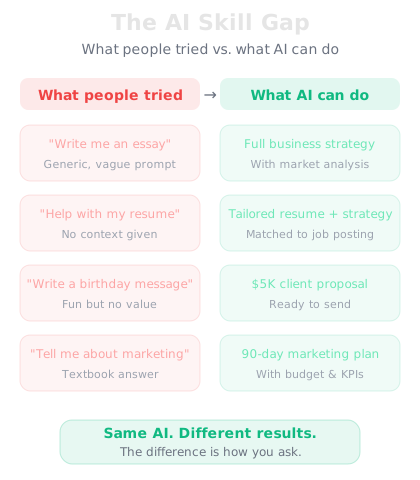
The gap between casual AI use and skilled AI use is the difference between "meh" and "mind-blowing."
The prompting problem
The issue isn't the tool. The issue is that nobody taught you how to use it.
Think about spreadsheets. If someone opened Excel for the first time and only typed numbers into cells, they'd conclude it's just a fancy calculator. They'd completely miss formulas, pivot tables, macros, and data visualization. Same tool — totally different experience based on skill level.
AI is the same way. The difference between a beginner prompt and an expert prompt isn't subtle — it's the difference between getting a C-minus essay and getting a strategy document that a McKinsey consultant would charge $10,000 for.
And here's the kicker: the AI didn't get better between those two prompts. You did.
I tried ChatGPT a few months ago and it just gave me generic answers. Has it actually gotten better?
Yes, it has gotten significantly better — but the bigger issue is probably how you're using it. Here's a quick test:
**Generic prompt:** "Give me marketing ideas for my business."
**Result:** Generic, forgettable suggestions.
**Specific prompt:** "I run a 3-person accounting firm in Denver. Our clients are small businesses with 5-20 employees. We want to add 10 new clients in Q2. Our budget for marketing is $2,000/month. What are the 5 highest-ROI marketing tactics for our specific situation, ranked by expected client acquisition cost?"
**Result:** Specific, actionable strategy tailored to your exact situation.
The AI is the same in both cases. The difference is entirely in the question. And yes — the models have also improved dramatically. Today's AI would outperform what you tried a few months ago, even with the same prompts.
↻ Replay conversation
Knowledge Check
Why do most people have an underwhelming first experience with AI?
A
They use vague, generic prompts and don't know how to leverage AI's full capabilities
B
Free versions of AI tools are intentionally limited
C
AI technology isn't actually very useful yet
D
AI only works well for technical people
The most common reason for disappointment is the skill gap in prompting. Most people ask vague questions and get vague answers — then conclude the tool isn't impressive. The tool is extremely capable; the bottleneck is knowing how to use it effectively.
Final Check
What's the best analogy for someone who tried AI and thought "it's not that impressive"?
A
Using a broken tool and blaming the manufacturer
B
Reading the first page of a book and understanding the story
C
Watching a movie trailer and knowing the whole plot
D
Test-driving a Ferrari in a parking lot and concluding it's not that fast
The Ferrari analogy captures it perfectly — the tool is extraordinary, but you need to take it out of the parking lot (vague prompts) and onto the highway (specific, context-rich prompts) to see what it can really do.
🔍
Day 3 Complete
"You didn't try AI and find it lacking. You tried driving a Ferrari in a parking lot. Take it on the highway."
Tomorrow — Day 4
The Speed of This
Tomorrow you'll see just how fast AI is improving — and why even experts keep getting caught off guard.