🦞 4minAI.com
1 / 8
Day 4 of 14 Β· What's Coming

The Speed of This

You've heard that AI is moving fast. But "fast" doesn't capture it. What's happening with AI is the fastest capability gain of any technology in human history. And if you don't understand the speed, you can't understand the urgency.

Let's put it in perspective.

A timeline that should make you uncomfortable

Here's what happened in just five years:

2020: AI could autocomplete your sentences. Impressive for a party trick. Useless for real work.

2021: AI could write passable paragraphs, but they felt robotic. Good for spam. Bad for anything serious.

2022: ChatGPT launched. AI could suddenly write essays, explain complex topics, and hold real conversations. The world noticed.

2023: AI passed the bar exam, medical licensing exams, and could write working code. It went from "interesting toy" to "wait, should I be worried?"

2024: AI could see images, generate photorealistic pictures, browse the internet, create videos, write entire applications, and reason through complex multi-step problems.

2025: AI agents can now operate autonomously β€” researching, planning, and executing multi-step tasks with minimal human input. They write code, manage projects, and coordinate workflows.

That's not five decades. That's five years.
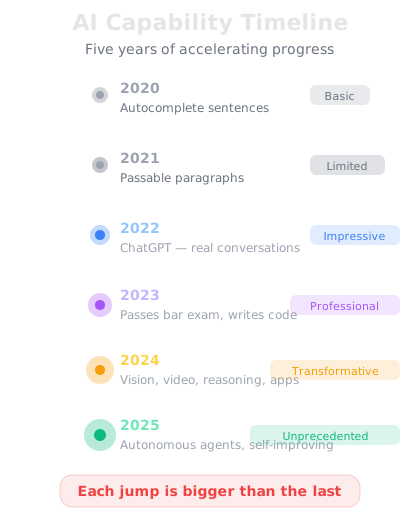
Vertical accelerating timeline showing AI capability jumps from 2020 to 2025
Five years of AI progress. Each jump is bigger than the last β€” and the pace is still accelerating.

Why your brain can't process this

Humans think linearly. If you walk 30 steps, you're 30 steps away. That's intuition.

But AI improves exponentially. If you take 30 exponential steps (doubling each time), you're not 30 steps away β€” you're over a billion steps away. That's the difference between walking across a room and walking to the moon. And back. Twice.

This is why even AI experts keep getting wrong about timelines. In 2020, top researchers predicted human-level AI by 2060 or later. By 2023, many had revised that to 2030. Now, some credible researchers think key milestones could arrive by 2027.

Every prediction about AI has been wrong in the same direction: it happened faster than expected.

Not once. Not twice. Every. Single. Time.

πŸ€–
ChatGPT
online
If AI is improving this fast, when will it actually affect my daily life?
It already is β€” you just might not have noticed yet. Your email's spam filter, your phone's photo search, your streaming recommendations, your GPS routing β€” all AI. But those are the quiet changes. The loud changes are coming fast: β€’ **2025-2026:** AI assistants that can manage your calendar, draft emails, and handle routine work tasks autonomously β€’ **2026-2027:** AI that can replace significant portions of knowledge work β€” analysis, writing, research, planning β€’ **2027+:** AI systems that can learn new skills on their own and tackle complex, multi-domain problems The honest answer: it's already affecting your daily life. The question is whether you're using it intentionally or just being affected by it passively.
↻ Replay conversation
Knowledge Check
What pattern have AI timeline predictions consistently followed?
A
Predictions alternate between too optimistic and too pessimistic
B
Predictions have been roughly accurate
C
Every prediction has been wrong in the same direction β€” AI arrived faster than expected
D
Experts have consistently overestimated AI's progress
There's a striking pattern in AI predictions: experts have consistently underestimated the speed of progress. What was predicted for 2060 is now expected by 2030 or sooner. This consistent one-directional error should inform how seriously you take current timelines.
Final Check
Why do humans struggle to understand the speed of AI progress?
A
The media exaggerates AI capabilities
B
AI companies deliberately hide their progress from the public
C
AI progress is actually slower than people think
D
Humans think linearly, but AI improves exponentially β€” and exponential growth is counterintuitive
Our brains are wired for linear thinking. Exponential growth feels impossible until it's obvious β€” and by then, you're already behind. That's why 30 linear steps cross a room, but 30 exponential steps reach the moon.
⚑
Day 4 Complete
"Every prediction about AI has been wrong in the same direction: it happened faster than expected. Plan accordingly."
Tomorrow β€” Day 5
AI Is Building the Next AI
Tomorrow you'll learn about the AI feedback loop β€” the mechanism that makes this wave unstoppable.
πŸ”₯1
1 day streak!