Day 8 of 20 · AI for Teachers
Marking and Feedback at Scale
⏱ 7 min
📊 Beginner
Let's talk about the elephant in every staffroom: marking. It's Sunday evening. You've got 30 exercise books on the dining table, a rubric you can barely remember, and a creeping sense of dread. You know each piece deserves thoughtful feedback. You also know that by book 22, your comments will shrink to "good effort" and a tick.
This isn't a failure of commitment. It's a failure of time. The research is clear — quality feedback is one of the highest-impact things a teacher can do. But the system gives you 90 students and expects personalised comments on every piece of work.
AI doesn't replace your professional judgement. But it can dramatically reduce the time between reading a student's work and delivering meaningful, personalised feedback. Today you'll learn how.
The marking workflow that changes everything
Here's the core approach. It's simple, and it works for essays, short answers, practical write-ups, and extended responses across any subject:
Step 1: Feed in your rubric. Paste or type your marking criteria, success criteria, or mark scheme. Be specific — include grade boundaries, key indicators, and what you're looking for at each level.
Step 2: Feed in the student response. Paste the student's work (or a typed-up version of it). One piece at a time, or batch several together.
Step 3: Ask for draft feedback. AI generates feedback aligned to your rubric — strengths, areas for development, and specific next steps.
Step 4: Review, adjust, and personalise. This is non-negotiable. You read the feedback, tweak it to match what you know about that student, and make it yours.
The key word in this entire workflow is draft. AI produces a draft. You produce the final version. The AI saves you from staring at a blank comment box for the 30th time — but your professional knowledge of that student, their context, and their journey is what makes the feedback meaningful.
Knowledge Check
What is the most important step in the AI-assisted marking workflow?
A
Pasting the student's work into AI as quickly as possible
B
Giving students the AI feedback exactly as it comes out
C
Using the most expensive AI tool available
D
Reviewing and personalising the AI's draft feedback before giving it to students
AI generates a draft — never a finished product. You know your students. You know that Priya needs encouragement because her confidence is fragile. You know that Marcus needs a direct challenge because he coasts. The AI saves you time on the writing; your professional judgement makes the feedback actually land.
Formative vs summative — different prompts, different purposes
The way you prompt AI should change depending on what the marking is for.
Formative feedback (ongoing, developmental): You want comments that help students improve right now. Focus on specific, actionable next steps. Use prompts like: "Identify two strengths and one specific area for improvement. Give the student a concrete action they can take in their next piece of work."
Summative feedback (end of unit, formal assessment): You want comments aligned tightly to grade descriptors and assessment criteria. Use prompts like: "Assess this response against the following mark scheme. Award a mark and justify the grade with reference to specific criteria. Note what the student would need to do to reach the next grade boundary."
Peer assessment preparation: You can use AI to generate model answers at different levels, so students can see what a Grade 4, Grade 6, and Grade 8 response looks like before they assess each other's work.
Getting the prompt right for the purpose saves you from having to rewrite the AI's output. Be explicit about what kind of feedback you need.
Knowledge Check
How should your AI prompt differ between formative and summative marking?
A
Summative feedback doesn't need AI because it's just a number
B
Formative prompts should focus on actionable next steps; summative prompts should reference specific grade criteria and boundaries
C
There's no difference — feedback is feedback
D
Formative prompts should be longer than summative prompts
Formative feedback is about growth — "here's what to do next." Summative feedback is about judgement — "here's where you are against the standard." AI can do both brilliantly, but you need to tell it which one you want. The prompt shapes the output.
Prompt templates you can use tomorrow
Here are ready-to-use prompt templates. Copy them, adjust for your subject, and start saving hours.
Essay feedback (formative):
"Here is my marking rubric: [paste rubric]. Here is a student's essay: [paste essay]. Provide feedback with: two specific strengths with evidence from the text, one area for development with a specific example from their writing, and one actionable target for their next essay. Write in second person ('you'). Tone: warm but honest. Keep it under 150 words."
Short answer marking (summative):
"Here is the mark scheme: [paste mark scheme]. Here are 10 student responses to this question: [paste responses]. For each student, award a mark out of [X] and write a one-sentence justification referencing the mark scheme."
Peer assessment preparation:
"Generate three model answers to this question: [paste question]. Write one at a low level, one at a mid level, and one at a high level. Use the following success criteria to differentiate: [paste criteria]. Label each clearly. These will be used by students to calibrate their peer assessment."
Maintaining your voice
Here's something that matters more than most teachers realise: students know when feedback doesn't sound like you. If you normally write "Brilliant use of evidence here, Aisha — this is exactly what I was looking for" and suddenly your comments read like a corporate report, they'll notice. And they'll care less.
Two ways to keep your voice:
Option 1: Give AI your voice. Paste in 3-4 examples of feedback comments you've written before. Tell AI: "Match this tone and style when generating feedback. Notice how I address students, the level of formality, and how I phrase praise and targets." AI picks up on your patterns quickly.
Option 2: Use AI for content, add voice yourself. Let AI identify the strengths, weaknesses, and targets. Then rewrite the opening and closing in your own words. This is faster than writing from scratch but still sounds unmistakably like you.
Either way, the goal is the same: feedback that feels personal, because it is. AI handles the heavy lifting of analysis. You handle the human connection.
I teach Year 10 English. Here's my rubric for a persuasive writing assessment:
Band 5 (13-16): Compelling, convincing writing. Varied and effective structural features. Extensive vocabulary. Secure control of grammar.
Band 4 (9-12): Convincing writing with clear structure. Conscious vocabulary choices. Generally secure grammar.
Band 3 (5-8): Attempts to be persuasive with some success. Some structural features. Reasonable vocabulary. Grammar mostly accurate.
Here are three student responses to "Write a speech persuading your headteacher to ban homework."
Student A (Jake): "Homework is pointless and no one likes it. We spend all day in school working hard and then we have to go home and do more work. It's not fair. Teachers don't even mark it properly half the time so what's the point. We should ban it because it causes stress and kids need time to be kids. Thank you for listening."
Student B (Fatima): "Picture this: a classroom full of tired, disengaged students, slumped over desks because they were up until midnight finishing homework that taught them nothing new. This is the reality in schools across the country, and it's time for a change. Research from the University of Oxford shows that homework has minimal impact on academic achievement for students under 16. So why are we persisting with a system that steals our evenings, damages our mental health, and produces no measurable benefit?"
Student C (Ollie): "I think homework should be banned because it is boring and takes up time. Some people have clubs after school and they can't do homework as well. My mum says homework stresses the whole family out. Also some kids don't have a quiet place to work at home so it's not fair on them."
Give each student a band and mark, then write formative feedback — two strengths and one target — in a warm, encouraging tone. Address each student by name.
**Jake — Band 3 (7/16)**
Jake, there's real passion in this piece — you clearly feel strongly about the topic, and that energy comes through. Your argument about needing time to be kids is a genuinely effective point that many readers would connect with.
Two strengths:
- You've taken a clear position and maintained it throughout — there's no confusion about where you stand
- Your point about teachers not marking homework is a bold, provocative argument that could be really powerful with more development
Target for next time: Try using a rhetorical question or a direct address to the audience to open your speech. Instead of "Homework is pointless," imagine starting with "How many of you stayed up past your bedtime last night finishing homework you didn't understand?" — that pulls the reader in immediately.
---
**Fatima — Band 5 (14/16)**
Fatima, this is a strong, confident piece of persuasive writing. You should be really proud of this.
Two strengths:
- Your opening image — "a classroom full of tired, disengaged students" — is vivid and immediately draws the reader in. That's a sophisticated structural choice
- You've used evidence (the Oxford University research) to support your argument, which lifts this above opinion and into genuine persuasion
Target for next time: To push this into the top of Band 5, try varying your sentence lengths for dramatic effect. After a long, complex sentence, drop in a short, punchy one. "This needs to stop." That contrast creates rhythm and impact.
---
**Ollie — Band 3 (5/16)**
Ollie, you've made some fair points here — and the one about not everyone having a quiet place to work at home is actually a really thoughtful observation. That shows you're thinking about other people's experiences, not just your own.
Two strengths:
- You've included multiple different reasons to support your argument, which shows you can think of more than one angle
- Your point about fairness for students without a quiet home environment is a mature, empathetic argument — it's your strongest point
Target for next time: Try developing one of your points in more detail rather than listing several briefly. Take your strongest argument — the one about home environments — and spend a whole paragraph on it. Explain why it matters, give an example, and tell us what it means. Depth beats breadth in persuasive writing.
↻ Replay conversation
What just happened — and the ethics you must follow
That conversation produced three pieces of personalised, rubric-aligned feedback in about 30 seconds. Feedback that references the student's actual words, identifies genuine strengths, and gives specific, actionable targets.
Doing that manually would take 15-20 minutes. Across a full class of 30, that's hours saved.
But — and this is critical — you must review every piece of feedback before a student sees it. Here's why:
AI can misread student intent. It can miss cultural context. It can praise something you wouldn't, or overlook something important. It doesn't know that Jake has been struggling with confidence this term, or that Fatima is applying for a scholarship and needs to be pushed harder.
The rule is simple: AI drafts, you decide. Every comment gets your eyes before it gets to a student. No exceptions. This isn't optional — it's a professional and ethical responsibility.
Knowledge Check
Why must teachers always review AI-generated feedback before sharing it with students?
A
AI doesn't know the individual student's context, confidence, or circumstances
B
AI feedback always contains factual errors
C
School policies require all marking to be done by hand
D
AI feedback is always too positive
AI produces feedback based on the text alone. It doesn't know that a student is going through a tough time at home, needs extra encouragement, or should be challenged harder. Your professional knowledge of each child is what turns generic feedback into meaningful guidance. Always review, always personalise.
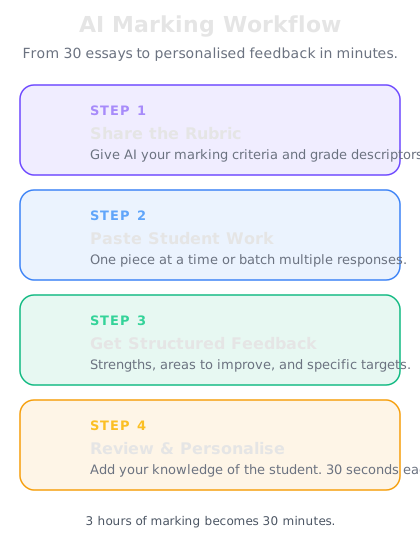
The AI marking workflow — AI handles the drafting, you handle the judgement.
Start small, build confidence
You don't have to overhaul your entire marking process today. Start with one class. One set of books. One assignment.
Try it with formative comments first — the stakes are lower and you'll get comfortable with the workflow before you use it for summative assessments.
Keep a copy of your rubric saved somewhere you can paste it quickly. Build a small library of prompt templates for your most common assessment types. Within a week, you'll have a marking workflow that saves you hours — and your students will still get the thoughtful, personalised feedback they deserve.
Because here's the truth: the best feedback in the world is useless if it sits in your head because you ran out of time to write it. AI makes sure it actually reaches the student.
Final Check
What's the best way to start using AI for marking?
A
Only use AI for the students who are struggling
B
Immediately use AI for all summative assessments across every class
C
Wait until your school has an official AI policy
D
Start with one class and formative comments to build confidence before scaling up
Starting small lets you learn the workflow, refine your prompts, and build trust in the process. Once you're confident with formative feedback for one class, you can expand to other classes and assessment types. Trying to do everything at once leads to mistakes and frustration.
📚
Day 8 Complete
"AI drafts, you decide. Every comment gets your eyes before it reaches a student — but now you're reviewing and refining, not writing from scratch."
Tomorrow — Day 9
Quiz & Test Generation
Tomorrow you'll generate quizzes, tests, and mark schemes aligned to your curriculum — in minutes instead of hours.