Day 9 of 20 · AI for Teachers
Quiz & Test Generation
⏱ 7 min
📊 Beginner
You need an end-of-unit test by Friday. You know exactly what it should cover. You can picture the question types in your head. But between now and Friday, you have 22 lessons to teach, a parents' evening to prepare for, and a duty rota that keeps stealing your free periods.
So you do what every teacher has done at some point: you pull an old test from the shared drive, change a few questions, and hope it's good enough. Or you spend two hours on Sunday evening building one from scratch, wondering if there's a better use of your time.
There is. AI can generate quizzes, tests, and mark schemes aligned to your curriculum in minutes. Not generic, low-quality questions — properly structured assessments with the right mix of difficulty, question types, and clear marking criteria. Today you'll learn how.
What AI can generate — and what it's good at
AI handles assessment generation brilliantly because assessments are structured. They follow predictable formats with clear rules. That's exactly the kind of task AI excels at.
Here's what you can generate:
Multiple choice questions with plausible distractors (not obviously wrong answers). AI is surprisingly good at creating wrong-but-reasonable options that actually test understanding rather than reading comprehension.
Short answer questions with model answers and acceptable alternative responses. You can specify the number of marks and AI will adjust the expected depth accordingly.
Extended response questions with detailed mark schemes, including indicative content at different grade levels.
Diagnostic assessments designed to identify specific misconceptions before you start teaching a topic.
Retrieval practice quizzes — low-stakes, spaced-repetition-style questions that test knowledge from previous topics.
The key is being specific about what you want. "Write a quiz on photosynthesis" gives mediocre results. "Write a 10-question quiz on photosynthesis for Year 9, covering the light-dependent and light-independent reactions, including 6 multiple choice and 4 short answer questions at grades 4-6 difficulty" gives excellent results.
Knowledge Check
Why does AI generate better assessments when given specific parameters?
A
It doesn't matter — AI generates the same quality regardless of the prompt
B
Specifics like year group, topic details, question types, and difficulty level guide the AI to produce targeted, curriculum-aligned output
C
Specific prompts take longer for AI to process, which improves quality
D
AI needs more text in the prompt to work properly
AI mirrors the precision of your prompt. When you specify the year group, exact topic content, question types, mark allocation, and difficulty level, the output matches those parameters closely. Vague prompts produce vague assessments. Detailed prompts produce assessments you can actually use.
Aligning questions to Bloom's taxonomy
One of the most powerful things you can do with AI-generated assessments is specify the cognitive demand of each question. Most teacher-made tests accidentally cluster around the same level — usually recall or basic application. AI can help you deliberately spread questions across thinking levels.
Here's how to prompt for different levels:
Remember/Recall: "Write 3 questions that test factual recall of key terms and definitions."
Understand: "Write 2 questions that require students to explain a concept in their own words or give an example."
Apply: "Write 2 questions that present a new scenario and ask students to apply their knowledge to solve it."
Analyse: "Write 1 question that asks students to compare, contrast, or identify relationships between concepts."
Evaluate: "Write 1 question that asks students to make a judgement, assess evidence, or critique an argument."
Create: "Write 1 extended response question that asks students to design, propose, or construct something new using their knowledge."
You can include this breakdown directly in your prompt: "Create an assessment with questions at these cognitive levels: 3 recall, 2 understanding, 2 application, 1 analysis, 1 evaluation, 1 creation." AI will structure the test accordingly, with difficulty building progressively.
Mark schemes — generated alongside, not as an afterthought
Here's where the real time savings are. Writing a mark scheme takes as long as (sometimes longer than) writing the test itself. AI generates both simultaneously.
When you prompt for a test, always include: "Generate a detailed mark scheme alongside each question."
Specify what you want in the mark scheme:
- For multiple choice: The correct answer and a brief explanation of why each distractor is wrong (useful for going through the test with students afterwards)
- For short answer: The model answer, acceptable alternative responses, common misconceptions to watch for, and marks allocation
- For extended response: Indicative content, grade-level descriptors, and what distinguishes a top-level answer from a middle-level one
This saves you from the all-too-common situation of writing a great test, handing it out, then realising at 9pm that you haven't written the mark scheme and need to mark 30 papers by tomorrow morning.
Knowledge Check
What should you always request alongside AI-generated test questions?
A
A lesson plan to teach the content
B
A set of revision resources for students
C
A letter to parents explaining the test
D
A detailed mark scheme with model answers, acceptable alternatives, and common misconceptions
The mark scheme is where the real time saving happens. AI generates it alongside the questions, so you have model answers, marking criteria, and grade descriptors ready before students even sit the test. No more Sunday-night mark-scheme panic.
I need an end-of-unit test for GCSE Biology (AQA), Topic 4: Bioenergetics. The test is for a mixed-ability Year 10 class. Include:
- 6 multiple choice questions (2 marks each)
- 3 short answer questions (3 marks each)
- 1 extended response question (6 marks)
Total: 27 marks. Time: 35 minutes.
Cover: photosynthesis (including rate factors), aerobic respiration, anaerobic respiration, and metabolism.
Generate a full mark scheme alongside each question. Include common misconceptions to watch for.
**GCSE Biology — Topic 4: Bioenergetics — End of Unit Test**
*Total: 27 marks | Time: 35 minutes*
---
**Section A: Multiple Choice (12 marks)**
**1.** Which word equation correctly describes aerobic respiration? (2 marks)
A) Glucose + oxygen → carbon dioxide + water
B) Glucose → lactic acid
C) Glucose + carbon dioxide → oxygen + water
D) Carbon dioxide + water → glucose + oxygen
*Mark scheme: A. Option D is the equation for photosynthesis — common misconception where students confuse the two. Option B describes anaerobic respiration in animals.*
**2.** A student investigates the effect of light intensity on photosynthesis using pondweed. As they move the lamp closer, the rate of bubble production increases, then levels off. What is the most likely limiting factor when the rate levels off? (2 marks)
A) Light intensity
B) Carbon dioxide concentration or temperature
C) Amount of water available
D) Size of the pondweed
*Mark scheme: B. Common misconception: students often say light intensity is still the limiting factor. At the plateau, another factor (CO₂ or temperature) has become limiting.*
**3.** Where in the cell does aerobic respiration mostly take place? (2 marks)
A) Nucleus
B) Cell membrane
C) Mitochondria
D) Chloroplast
*Mark scheme: C. Common misconception: students often confuse mitochondria (respiration) with chloroplasts (photosynthesis).*
**4.** Which of these is a product of anaerobic respiration in yeast? (2 marks)
A) Lactic acid
B) Ethanol and carbon dioxide
C) Oxygen and glucose
D) Water and carbon dioxide
*Mark scheme: B. Common misconception: students apply animal anaerobic respiration (lactic acid) to yeast. Yeast produces ethanol and CO₂ (fermentation).*
**5.** What is metabolism best described as? (2 marks)
A) The breakdown of food in the stomach
B) The sum of all chemical reactions in a cell or organism
C) The process of converting glucose to energy
D) The removal of waste products from the body
*Mark scheme: B. Common misconception: students confuse metabolism with just respiration or digestion. It includes ALL chemical reactions — building up and breaking down.*
**6.** The inverse square law relates to which factor affecting the rate of photosynthesis? (2 marks)
A) Temperature
B) Light intensity
C) Carbon dioxide concentration
D) Chlorophyll concentration
*Mark scheme: B. Light intensity is inversely proportional to the square of the distance. Students often know the term but can't connect it to practical work.*
---
**Section B: Short Answer (9 marks)**
**7.** Explain why the rate of photosynthesis increases as temperature rises from 10°C to 35°C, but then decreases above 45°C. (3 marks)
*Mark scheme: 1 mark — increased temperature gives molecules more kinetic energy / more frequent collisions between enzyme and substrate. 1 mark — above optimum, enzymes begin to denature. 1 mark — active site changes shape so substrate can no longer fit. Watch for: students saying enzymes "die" rather than denature.*
**8.** During intense exercise, a sprinter's muscles switch from aerobic to anaerobic respiration. Explain why this happens and name the waste product that builds up. (3 marks)
*Mark scheme: 1 mark — muscles need more energy / respiring faster. 1 mark — oxygen cannot be delivered fast enough for aerobic respiration. 1 mark — lactic acid builds up. Watch for: students saying "the body runs out of oxygen" — it doesn't run out; supply can't meet demand.*
**9.** A farmer wants to maximise crop growth in a greenhouse. Suggest three conditions they could control and explain how each affects the rate of photosynthesis. (3 marks)
*Mark scheme: 1 mark each for any three valid factor-explanation pairs: increase light intensity (more energy for light-dependent reactions), increase CO₂ concentration (more carbon for glucose production), optimise temperature (enzyme activity at optimum). Accept: use of heaters, CO₂ generators, artificial lighting.*
---
**Section C: Extended Response (6 marks)**
**10.** Compare aerobic and anaerobic respiration. In your answer, include the reactants and products of each, where each occurs in the cell, the relative energy released, and give one situation where each type is important in the human body. (6 marks)
*Mark scheme:*
*Level 3 (5-6 marks): Detailed comparison covering all four aspects. Clear, logical structure. Correct terminology throughout.*
*Level 2 (3-4 marks): Covers at least three aspects with mostly correct detail. Some comparison rather than just description.*
*Level 1 (1-2 marks): Basic recall of one or two aspects. May contain errors. Limited comparison.*
*Indicative content: Aerobic — glucose + oxygen → CO₂ + water, in mitochondria, releases more energy, sustained exercise. Anaerobic — glucose → lactic acid (animals), in cytoplasm, releases less energy, short bursts of intense exercise. Key comparison: efficiency and oxygen requirement.*
↻ Replay conversation
That test would have taken you two hours
Let's be honest about the time. Building a 27-mark test with balanced question types, Bloom's-aligned difficulty progression, a full mark scheme with common misconceptions, and curriculum-specific content — that's a full evening's work.
AI produced it in under a minute. You now spend 10-15 minutes reviewing it: checking the content is accurate, adjusting questions that don't quite hit the right level, and tweaking the language to match your students. That's a 90% time saving on assessment creation.
And here's a bonus most teachers don't think about: you can ask AI to generate parallel versions. Need a different version for the student who was absent? Need a slightly easier version for a supported group? Need a harder extension for your top set? Just ask: "Create a parallel version of this test at a slightly lower difficulty level, covering the same topics."
Knowledge Check
How can AI help you create differentiated assessments efficiently?
A
Differentiated assessments aren't necessary if the mark scheme is clear
B
Ask AI to generate parallel versions of the same test at different difficulty levels
C
AI can only create one version of any test
D
Use the same test for everyone and mark it differently
Generating parallel versions is one of AI's strongest features for assessment. Same topics, same structure, adjusted difficulty — and each version takes seconds to generate. This means you can provide appropriate challenge for every group without spending three hours creating three separate tests.
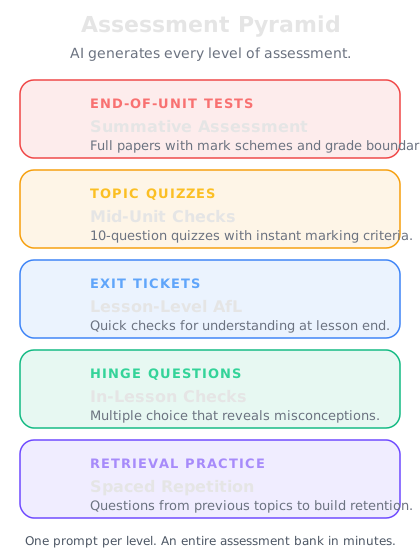
Build assessments deliberately — from recall at the base to evaluation at the top.
Diagnostic assessments — find the gaps before you teach
One more powerful use case: diagnostic assessments. These are short quizzes you give before teaching a topic, designed to reveal what students already know and where their misconceptions are.
Prompt: "Create a 10-question diagnostic quiz for [topic]. Include questions that test prerequisite knowledge students should already have, and questions that reveal common misconceptions about [specific concepts]. Include a teacher analysis guide that explains what each wrong answer tells me about the student's understanding."
That last line — "what each wrong answer tells me" — is gold. It turns a diagnostic from a simple right/wrong score into a genuine insight tool. If 18 out of 30 students choose the same wrong answer on question 4, that tells you exactly where to focus your teaching.
AI turns assessment creation from a chore into a strategic tool. You're not just testing — you're learning about your learners.
Final Check
What makes diagnostic assessments especially powerful when created with AI?
A
Diagnostic assessments don't need a mark scheme
B
AI can explain what each wrong answer reveals about student misconceptions, turning the quiz into a teaching tool
C
Students prefer diagnostic assessments over other test types
D
Diagnostic assessments are easier for AI to generate than other types
When AI explains the reasoning behind each distractor — "If a student chose B, they likely confuse respiration with photosynthesis" — you get actionable intelligence about your class before you've even taught the topic. That's assessment as a teaching tool, not just a measuring stick.
📚
Day 9 Complete
"Stop spending Sunday evenings building tests from scratch. Give AI your topic, year group, and question types — and spend your time reviewing, not creating."
Tomorrow — Day 10
Data & Tracking Made Easy
Tomorrow you'll use AI to analyse assessment data, spot gaps, and identify which students need intervention — without wrestling with spreadsheets.