Day 19 of 28 · AI Job Hunt
Behavioral Interview Stories
⏱ 5 min
📊 Beginner
"Tell me about a time when..." — if you've ever frozen at this question, you're not alone. Behavioral questions feel hard because they require you to recall a specific story, structure it coherently, and deliver it confidently — all in real time.
The fix is simple: don't improvise. Prepare 6-8 stories in advance that cover the most common behavioral themes. Today, AI helps you build your story bank.
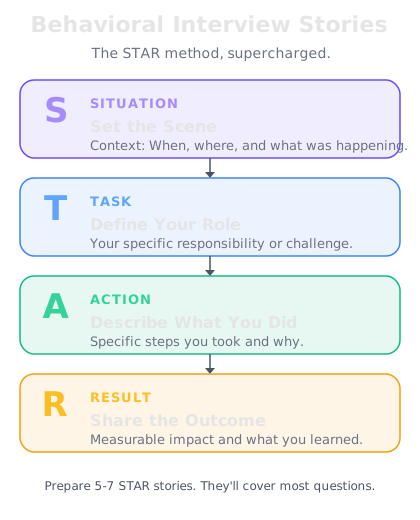
The STAR method, supercharged with AI.
The STAR method
Every behavioral answer should follow the STAR framework:
Situation: Set the scene in 1-2 sentences. What was happening?
Task: What was your specific responsibility or challenge?
Action: What did you personally do? This is the longest section. Be specific about YOUR decisions and actions — not what "we" did.
Result: What happened? Quantify it if possible. What did you learn?
The biggest mistake people make: spending too long on Situation and Task, and rushing through Action and Result. Flip that. The Action is what they care about most — it shows how you think and work.
Knowledge Check
In the STAR method, which section should get the most time in your answer?
A
Task — they need to understand the challenge
B
Action — interviewers want to hear YOUR specific decisions, approach, and contributions
C
Result — the outcome is all that matters
D
Situation — setting the scene is crucial
The Action section is where you differentiate yourself. Two people can face the same Situation and Task — what matters is what YOU specifically did. Did you take initiative? Did you collaborate? Did you think creatively? The Action section is your proof of capability.
Help me prepare a STAR story. Here's the raw experience: Last year, two of our biggest clients were unhappy at the same time. One was frustrated with slow support response times, the other was threatening to cancel because a feature they needed kept getting delayed. I had to manage both situations while keeping my team motivated. We ended up retaining both clients and one of them expanded their contract.
Here's your STAR story:
**Situation (2 sentences):**
"Last year, two of our largest accounts — together representing $400K in ARR — flagged as at-risk within the same week. One was frustrated with support response times; the other was considering cancellation because a critical feature they needed kept slipping on our roadmap."
**Task (1 sentence):**
"As the senior CSM, I owned both relationships and needed to prevent churn while keeping my team's morale intact during a stressful period."
**Action (the meat — 4-5 sentences):**
"I took different approaches for each account. For the support client, I dug into the ticket data and found that 60% of their issues were about the same integration bug. I escalated it to engineering with a business case showing the revenue at risk, and it got patched in 5 days. For the feature-delay client, I scheduled a direct call between them and our product lead so they felt heard — and I built a custom workaround using our API that solved 80% of their need in the interim. For my team, I was transparent about the stakes and gave each person ownership of specific action items rather than absorbing everything myself."
**Result (2 sentences):**
"Both accounts renewed. The support client's satisfaction score went from 6 to 9, and the feature-delay client expanded their contract by $50K within three months. I also used the experience to build an 'at-risk playbook' that my team now uses for every escalation."
---
**This story demonstrates:** Leadership under pressure, stakeholder management, cross-functional collaboration, creative problem-solving, and team development.
↻ Replay conversation
The 8 stories you need
Most behavioral questions fall into 8 categories. Prepare one strong STAR story for each:
1. Leadership/Initiative: A time you took charge or went beyond your role.
2. Conflict resolution: A disagreement with a colleague, client, or manager.
3. Failure/Mistake: Something that went wrong and what you learned.
4. Teamwork/Collaboration: Working with others to achieve a goal.
5. Problem-solving: A complex challenge you figured out.
6. Pressure/Deadlines: Delivering under time pressure or competing priorities.
7. Persuasion/Influence: Convincing someone to change their mind or approach.
8. Growth/Learning: A time you developed a new skill or adapted quickly.
With 8 stories prepared, you can answer virtually any behavioral question by selecting the most relevant story and adapting it slightly.
Knowledge Check
Why prepare 8 stories instead of just memorizing answers to specific questions?
A
Because interviewers always ask exactly 8 questions
B
Because the same story can answer multiple different questions — "tell me about a conflict" and "tell me about a time you influenced someone" might use the same story with a different emphasis
C
Because you'll forget individual answers under pressure
D
Because 8 is a lucky number
A story bank is flexible. Your "conflict resolution" story might also work for "tell me about a difficult stakeholder" or "tell me about a time you had to influence without authority." Having 8 strong stories gives you building blocks you can adapt to any question — instead of memorizing rigid scripts.
Building your story bank with AI
Here's your action step. Open AI and use this prompt:
"I need to prepare behavioral interview stories using the STAR method. Here are 5 experiences from my career: [list your experiences briefly — one sentence each]. For each one, help me structure it into a STAR story. Make the Action section the longest part. Include specific details and quantified results where possible."
Then ask: "Which of the 8 common behavioral categories does each story cover? Am I missing any categories? If so, can you help me think of an experience that might fit?"
In 20 minutes, you'll have a complete story bank that covers every behavioral theme. Practice telling each one out loud — they should feel natural, not memorized.
Final Check
What's the most common mistake in behavioral interview answers?
A
Making the story too short
B
Not using the STAR framework
C
Using stories from too long ago
D
Spending too long on the Situation and Task while rushing through Action and Result — the interviewer cares most about what YOU did and what happened
Most people over-explain the background and run out of time (or energy) before getting to the good part. The Action section is where you shine — your specific decisions, your initiative, your problem-solving. Practice keeping Situation and Task to 2-3 sentences so you have time to really dig into Action and Result.
📚
Day 19 Complete
"Behavioral interviews aren't about thinking on your feet. They're about preparing your best stories in advance and delivering them with confidence."
Tomorrow — Day 20
Technical and Case Interview Prep
Tomorrow you'll prepare for technical questions and case studies — even if you're not in a technical role.