Day 20 of 28 · AI Job Hunt
Technical and Case Interview Prep
⏱ 5 min
📊 Beginner
Not every interview is behavioral. Many roles include a technical component — a skills test, a case study, a presentation, or a take-home assignment. These can feel intimidating, but they're actually the best opportunity to stand out, because most candidates under-prepare.
Today, AI helps you prepare for whatever format they throw at you.
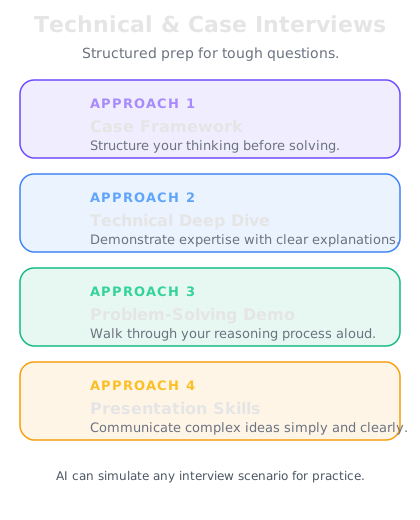
Structured prep for the toughest question formats.
The types of technical interviews
Different roles use different formats:
Case studies: "How would you launch this product into a new market?" Common in marketing, consulting, product, and strategy roles. Tests your thinking process, not just your answer.
Take-home assignments: "Create a marketing plan for this fictional product." Common in marketing, design, and content roles. Tests your actual work quality.
Technical skills tests: "Build a financial model" or "Write a SQL query." Common in analytics, finance, and engineering roles. Tests specific hard skills.
Presentations: "Present your 90-day plan for this role." Common in senior roles. Tests your strategic thinking and communication.
The good news: AI can help you prepare for all of them.
Knowledge Check
What do technical interviews primarily test?
A
Your thinking process and problem-solving approach — interviewers care as much about HOW you work as what you deliver
B
Whether you memorized enough facts
C
Whether you can complete tasks without any help
Technical interviews are about your process as much as your output. Interviewers want to see how you break down problems, what questions you ask, how you structure your approach, and how you communicate your reasoning. A perfect answer with no visible thought process is less impressive than a good answer with clear, logical reasoning.
I have a case study interview at a B2B SaaS company. The prompt is: "How would you launch our new AI analytics feature to our enterprise customer base?" Help me prepare a framework I can use to structure my answer.
Here's a proven framework for product launch case studies:
**1. Clarifying Questions (ask these first — it shows strategic thinking):**
- Who's the primary persona? (IT decision-makers? Data analysts? C-suite?)
- Is this an add-on or included in existing plans?
- What's the timeline? Soft launch or big-bang?
- What does success look like? (Adoption %? Revenue? Retention impact?)
**2. Market Understanding:**
- Customer pain point this solves
- Competitive landscape (who else offers AI analytics?)
- Differentiation (why ours is better/different)
**3. Positioning & Messaging:**
- Core value proposition (1 sentence)
- Key messaging pillars (3 reasons to believe)
- Objection handling (concerns about AI accuracy, data privacy)
**4. Go-to-Market Strategy:**
- Internal enablement (sales team, CS team)
- Launch sequence (beta → soft launch → GA)
- Channels (email, webinar, in-app, sales-led demos)
- Content (case studies, demo videos, comparison guides)
**5. Measurement:**
- Leading indicators (demo requests, trial activations)
- Lagging indicators (adoption rate, revenue impact, NPS)
- Timeline for evaluation
**Pro tip:** Don't try to cover everything perfectly. Interviewers prefer depth on 2-3 areas over surface coverage of everything. Pick your strongest areas and go deep.
↻ Replay conversation
Preparing for take-home assignments
Take-home assignments are actually great for AI-powered candidates. Here's why: you have time and privacy to use AI as your thinking partner.
The right way to use AI for take-homes:
Use AI to brainstorm approaches, generate first drafts, analyze data, and pressure-test your reasoning. But the final work should clearly reflect YOUR thinking, YOUR judgment, and YOUR voice.
The wrong way:
Copy-pasting AI output directly. Interviewers can often tell, and you won't be able to defend your work in the follow-up discussion.
The process:
1. Read the brief carefully. Note what they're really evaluating.
2. Brainstorm with AI: "Here's the assignment. What are the key dimensions I should address?"
3. Draft with AI assistance — but add your own insights, data points, and recommendations.
4. Review and polish in your own voice.
5. Prepare to present and defend every decision.
Knowledge Check
What's the right way to use AI for take-home interview assignments?
A
Don't use AI at all — it's cheating
B
Use AI as a brainstorming and drafting partner, but ensure the final work reflects your own thinking and voice — you must be able to defend every element
C
Generate the entire output with AI and submit it
D
Only use AI for formatting and spell-checking
AI is a tool, like a calculator in a finance interview. Using it to brainstorm, structure, and draft is smart and efficient. But the final product needs to be yours — your insights, your recommendations, your voice. If you can't explain every choice you made, the interviewer will know it wasn't your work.
The AI mock interview
One of the most powerful prep techniques: have AI run a mock interview with you.
"You're a VP of Marketing at a B2B SaaS company interviewing me for a Product Marketing Manager role. Ask me one question at a time. Start with the case study: 'How would you launch our new AI feature?' After I answer, give me feedback on what was strong and what I should improve. Then ask the next question."
This gives you realistic practice with instant feedback. Do 3-4 rounds and you'll walk into the real interview having already answered variations of every question they'll ask.
Final Check
Why is practicing with an AI mock interview effective?
A
Because AI interviews are harder than real ones
B
Because AI asks the same questions as real interviewers
C
Because you can practice without embarrassment
D
Because AI gives you instant, specific feedback on your answers — helping you refine your structure, depth, and delivery before the real interview
The feedback loop is what makes it powerful. In a real interview, you don't know what you did wrong until the rejection email. With AI, you get immediate feedback: "Your STAR story spent too long on the situation — get to the action faster" or "You didn't quantify your results." Each round makes your answers sharper.
🧠
Day 20 Complete
"Technical interviews test your thinking, not your knowledge. AI helps you build frameworks that make your thinking visible, structured, and impressive."
Tomorrow — Day 21
Your Interview Toolkit
Tomorrow you'll assemble everything into a complete pre-interview preparation system.