Day 13 of 14 · What's Coming
This Isn't a Dinner Conversation
⏱ 6 min
📊 Beginner
There's a pattern that happens with every major technological shift: people talk about it at dinner parties, nod along, say "yeah, that's interesting" — and then do absolutely nothing about it.
Today's lesson is about why that pattern is more dangerous with AI than with any previous technology.
The dinner party trap
You've probably had this experience. Someone brings up AI at dinner. Everyone shares an opinion. Someone mentions ChatGPT. Someone else says their kid uses it for homework. There's a brief debate about whether AI will "really" change things.
Then the appetizers arrive, the topic changes, and nothing happens.
This is the dinner party trap. The conversation creates an illusion of engagement — you feel like you've "dealt with" the AI topic because you discussed it. But discussion isn't action. Awareness isn't preparation.
The gap between "I know AI is a big deal" and "I'm actively doing something about it" is where most people live. And it's a dangerous place to be.
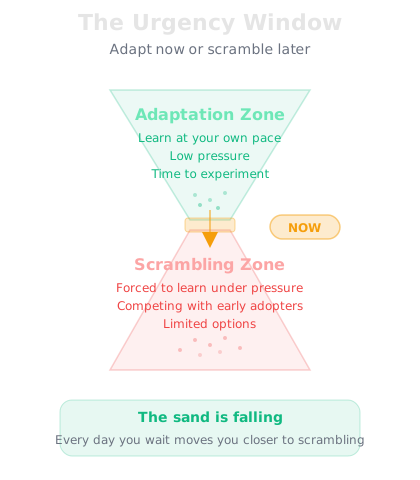
The adaptation window is open now — but it's narrowing. The difference between adapting calmly and scrambling desperately is timing.
Why urgency matters
Here's what makes AI different from other dinner-party topics like cryptocurrency or the metaverse:
AI isn't speculative. It's not a "maybe" technology. It's already integrated into the products and services you use daily. The question isn't whether it will affect you — it's when you'll feel it directly.
The window is closing. Right now, learning AI is optional. You can take your time, experiment casually, and build skills at your own pace. But that window is narrowing. As more companies adopt AI, as more jobs require AI skills, and as more competitors use AI — the pressure shifts from "nice to have" to "survive or don't."
Catching up gets harder. AI skills compound. Someone who's been using AI for six months has built intuitions, workflows, and capabilities that can't be learned in a weekend crash course. Every month you wait, the gap between you and the early adopters widens.
This isn't about fear. It's about the same rational urgency you'd feel if you saw flood warnings for your neighborhood. You wouldn't casually discuss floods at dinner and then go to bed. You'd start preparing.
I've been meaning to learn AI for months but I keep putting it off. What's wrong with me?
Nothing is wrong with you — this is completely normal human behavior. It's called the "urgency gap" and it happens with every major change.
**Why you procrastinate on AI:**
• There's no immediate crisis forcing action
• The topic feels overwhelming (where do you even start?)
• Your current routine works "fine" for now
• Change requires energy that your daily life already consumes
**How to break the loop:**
1. **Make it tiny.** Don't commit to "learning AI." Commit to opening ChatGPT once today and asking it one question about your work.
2. **Attach it to something you already do.** Next time you write an email, draft it in ChatGPT first. Next time you research something, ask AI before Googling.
3. **Set a deadline.** "By Friday, I will have used AI for three work tasks." Specific, measurable, short-term.
4. **Tell someone.** Accountability breaks procrastination. Tell a friend or colleague that you're starting.
You don't need motivation. You need one small action today.
↻ Replay conversation
Knowledge Check
What is the "dinner party trap" with AI?
A
People learn enough about AI from casual conversations
B
AI makes dinner party conversations less interesting
C
People argue about AI at dinner parties and ruin the evening
D
Discussing AI creates an illusion of engagement without any actual action or preparation
The dinner party trap is when discussing a topic makes you feel like you've addressed it — when you haven't done anything at all. Talking about AI creates a false sense of engagement that substitutes for the actual work of learning and adapting.
Final Check
Why is the AI adaptation window different from other technology trends?
A
There's no real urgency — AI is just another tech hype cycle
B
AI trends come and go faster than other technology trends
C
AI is already integrated into daily life, skills compound over time, and catching up gets exponentially harder
D
AI is more expensive than other technologies
Unlike speculative technologies, AI is already here and compounding. Those who start now build skills and intuitions that can't be crash-learned later. The window isn't about whether AI matters — it's about whether you adapt while it's still comfortable to do so.
⏳
Day 13 Complete
"Talking about AI isn't the same as doing something about it. The adaptation window is open now — but it won't be open forever."
Tomorrow — Day 14
Your Next Move
Tomorrow we'll wrap up with a concrete action plan — the specific steps to take after this course ends.