🦞 4minAI.com
1 / 9
Day 10 of 14 Β· What's Coming

Rethink Your Career

Knowing that AI is changing jobs (Day 6) is one thing. Having a strategy is another. Today we'll build that strategy β€” a practical framework for making your career AI-resilient.

The skill spectrum

Not all skills are equally vulnerable to AI. Think of it as a spectrum:

AI-vulnerable skills (left side): Tasks that are routine, rule-based, and information-heavy. Data entry. Basic writing. Standard analysis. Template-based work. Translation. Scheduling. These are being automated fastest.

AI-resilient skills (right side): Tasks that require complex human judgment, deep relationships, physical presence, or novel creativity. Strategic thinking. Empathy-driven leadership. Crisis management. Original creative vision. Complex negotiation. Physical craftsmanship.

Most people's jobs sit somewhere in the middle β€” a mix of vulnerable and resilient tasks. Your goal is to shift your mix toward the resilient end.
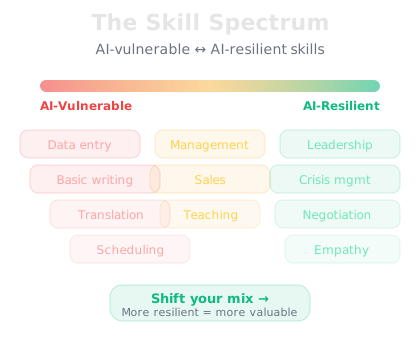
Horizontal spectrum showing AI-vulnerable skills on the left and AI-resilient skills on the right
Where do your daily tasks fall? The more you can shift right, the more AI-resilient your career becomes.

The three career moves

Here's your practical career playbook for the AI era:

Move 1: Become the AI person in your current role. Whatever you do now, become the person on your team who knows how to use AI to do it better. This is the fastest, lowest-risk move. You don't change jobs β€” you change how you do your job. The "AI person" on any team is the last one to be let go and the first one to be promoted.

Move 2: Move toward uniquely human skills. Actively develop skills that AI can't replicate β€” relationship building, leadership, complex judgment, creative direction. If your job is 80% tasks that AI could do, start volunteering for the 20% that requires human insight. Make that 20% your identity at work.

Move 3: Use AI to build leverage. Instead of just using AI to do your current job better, use it to build something on the side. A consulting practice. A content platform. A product. A service. AI gives you the ability to build things that previously required a team. Use that power to create options for yourself β€” so you're never fully dependent on a single employer.

What to stop doing

Just as important as what to start doing is what to stop investing in:

Stop banking on credentials alone. A degree or certification used to signal competence for decades. Now, the half-life of professional knowledge is shrinking. What matters is demonstrated capability, not a diploma.

Stop optimizing for one narrow specialty. Hyper-specialization was rewarded in the old economy. In the AI economy, adaptability and breadth are more valuable. The person who can use AI across multiple domains is more valuable than the expert in one domain who can't use AI at all.

Stop assuming stability. The idea that you'll work one role at one company for years is becoming less and less realistic. Build your career like a portfolio β€” diversified, with multiple income sources and skill sets.

πŸ€–
ChatGPT
online
I'm 45 and I've been in the same industry for 20 years. Is it too late for me to adapt?
Absolutely not β€” and here's why your experience is actually an advantage. **The AI advantage for experienced professionals:** 1. **You have domain expertise.** AI is a tool β€” it needs someone who understands the domain to use it effectively. A 45-year-old with 20 years of industry knowledge using AI will outperform a 25-year-old with great AI skills but no domain expertise. 2. **You have judgment.** You know what good output looks like in your field. When AI generates something, you can instantly tell if it's right or wrong. That judgment takes years to develop and AI can't replace it. 3. **You have relationships.** Clients, colleagues, and networks built over 20 years are irreplaceable by AI. **The move for you:** β€’ Learn AI tools specific to your industry (this takes weeks, not years) β€’ Combine your deep expertise with AI capability β€’ Position yourself as the person who bridges "old school knowledge" with "new school tools" Age isn't the barrier. Willingness to learn is. And the fact that you're in this course tells me you have that.
↻ Replay conversation
Knowledge Check
What's the most effective career strategy in the AI era?
A
Switch to a completely different career in technology
B
Earn as many certifications as possible before AI changes your industry
C
Become the person on your team who knows how to use AI to do the job better
D
Avoid AI and focus on being the best at your current skills
The lowest-risk, highest-impact career move is becoming the "AI person" in your current role. You leverage your existing expertise and relationships while adding AI capability β€” making yourself the most valuable and hardest-to-replace member of your team.
Final Check
Why is hyper-specialization becoming riskier in the AI era?
A
If AI can automate your narrow specialty, you have nothing to fall back on β€” adaptability and breadth are now more valuable
B
Specialization takes too long to learn
C
AI can only replace generalists, not specialists
D
Companies are hiring fewer specialists in general
In the AI economy, a narrow specialty can become automated overnight. The person who can use AI across multiple domains is more resilient than the expert in one domain who can't adapt. Build your career like a portfolio β€” diversified and adaptable.
🧭
Day 10 Complete
"Don't just learn AI tools. Shift your entire skill mix toward what AI can't replace β€” and use AI to build leverage and options."
Tomorrow β€” Day 11
Teach Your Kids
Tomorrow we'll talk about preparing the next generation β€” what to teach your kids about the AI-shaped world they're inheriting.
πŸ”₯1
1 day streak!