Day 20 of 20 · AI for Trades
Your Trades Business Future
⏱ 5 min
📊 Beginner
Twenty days ago, you started this course as a tradesperson who was good at your craft. Today, you are a tradesperson who is good at your craft and equipped with AI tools that most of your competitors do not even know exist.
That is not a small thing. That is a genuine competitive advantage in an industry where the difference between a fully booked diary and a quiet phone often comes down to who presents themselves better, responds faster, and runs a tighter operation.
Let us look at what you have built over the past three weeks — and where you go from here.
What you have built in 20 days
Week 1: Foundations. You set up AI tools, learned to write prompts that actually work, and started using AI to craft winning profiles on RatedPeople, Checkatrade, Thumbtack, Angi, hipages, and Bark. You learned to write descriptions that sell your skills and respond to leads in minutes instead of hours.
Week 2: Winning Work. You mastered AI-powered quote writing, learned to handle objections, used AI to gather and respond to reviews, and built professional communication templates. You turned your profiles from basic listings into lead-generating machines.
Week 3: Growing Your Business. You built a simple website, created follow-up sequences that convert quotes into bookings, developed a pricing strategy based on data instead of guesswork, set up a job management system, and learned how to scale from solo to a team with documented processes.
That is a complete business upgrade — from how you find work to how you price it, deliver it, and grow beyond it.
Knowledge Check
What is the single biggest advantage you now have over tradespeople who are not using AI?
A
You present more professionally, respond faster, follow up consistently, price smarter, and run a more organised operation — while they're still doing everything manually
B
You can do the trade work faster
C
AI replaces the need for trade skills
D
You have access to more expensive tools
AI does not make you a better plumber, electrician, or builder on the tools. What it does is make everything around the trade work faster and more professional — your profiles, quotes, follow-ups, pricing, and organisation. That combination wins more work and keeps customers coming back.
Your competitive edge
Let us be honest: most tradespeople will not adopt these tools. Not this year. Probably not next year either. Many are sceptical about AI. Many do not think it applies to them. Many will keep doing things the way they have always done them.
That is your advantage.
While they write quotes by hand that take 20 minutes, yours take 3 minutes and read like they were written by a marketing professional. While they hope customers call back after quoting, you have a three-message follow-up sequence running automatically. While they guess their prices, you have researched the market and present tiered options that guide customers toward better decisions.
The trades industry is not short of skilled people. It is short of skilled people who also run professional, well-organised businesses. You are now one of them.
And this edge compounds over time. Better profiles bring more leads. More leads mean more quotes. Better quotes with follow-ups mean more bookings. More bookings mean more reviews. More reviews mean better profiles. The cycle feeds itself.
Knowledge Check
Why does the competitive advantage of using AI compound over time?
A
Because each improvement feeds the next — better profiles bring more leads, more leads bring more reviews, more reviews improve your profiles, creating a growth cycle
B
Because AI gets cheaper every year
C
Because lead platforms give discounts to AI users
D
Because competitors will eventually give up
This is the compounding effect. A better profile brings more enquiries. More enquiries mean more quotes. AI-powered follow-ups convert more quotes into jobs. More completed jobs generate more five-star reviews. Those reviews make your profile even stronger. Each piece reinforces the others, and the gap between you and competitors who are not using these tools widens month after month.
I'm an electrician in Brisbane, Australia. I've finished the AI for Trades course and I want to put a 90-day growth plan together. I currently do about 8 jobs a week, mostly from hipages and word of mouth. I want to get to 12 jobs a week and start subcontracting overflow work. Can you map out a plan for me?
**Your 90-Day Growth Plan**
**Month 1 — Foundations (Days 1-30):**
- Week 1: Update your hipages profile using AI-written copy. Add 5 new project photos. Rewrite your service descriptions for each category you cover.
- Week 2: Build a one-page website on Carrd with your services, areas (Brisbane, Gold Coast, Logan, Ipswich), testimonials, and contact form. Cost: ~$19/year.
- Week 3: Set up your job tracker spreadsheet. Start logging every lead, quote, and outcome so you can see your conversion rate.
- Week 4: Create follow-up message templates for quotes, post-job reviews, and seasonal check-ins. Start using them on every job.
**Month 2 — Growth (Days 31-60):**
- Activate profiles on Bark and Oneflare alongside hipages to increase lead volume
- Use AI to write quotes in under 5 minutes — aim to respond to every lead within 30 minutes
- Implement the three-message follow-up sequence on all outstanding quotes
- Ask every completed job for a Google review — target 10 new reviews this month
- Start tracking your numbers: leads per week, quotes sent, jobs won, revenue
**Month 3 — Scale (Days 61-90):**
- Review your numbers. If you are consistently hitting 10-12 jobs/week, start looking for a subcontractor
- Use AI to write a subcontractor job ad. Post on local Facebook trade groups and Gumtree
- Create checklists for your three most common job types so a sub can deliver to your standard
- Set up a simple pricing structure: your jobs vs. subcontracted jobs, margins on each
- Target: 12 jobs/week with 3-4 handled by your sub, giving you capacity to grow further
**Key metrics to track:**
- Leads per week (target: 20+)
- Quote conversion rate (target: 40%+)
- Average job value
- Google review count
- Revenue per week
↻ Replay conversation
The tradesperson of tomorrow
The trades are not going anywhere. People will always need their pipes fixed, their houses wired, their roofs repaired, and their gardens built. AI does not change that.
What AI changes is how the business side works. The tradespeople who thrive over the next five years will be the ones who combine brilliant hands-on skills with smart business tools. They will win more work from lead platforms because their profiles are better. They will convert more quotes because their responses are faster and more professional. They will earn more per job because their pricing is strategic. And they will grow because their businesses are built on systems, not chaos.
You have spent 20 days building exactly that. The tools are set up. The templates are written. The systems are in place. Now it is about execution — using them every day until they become second nature.
Go win some work.
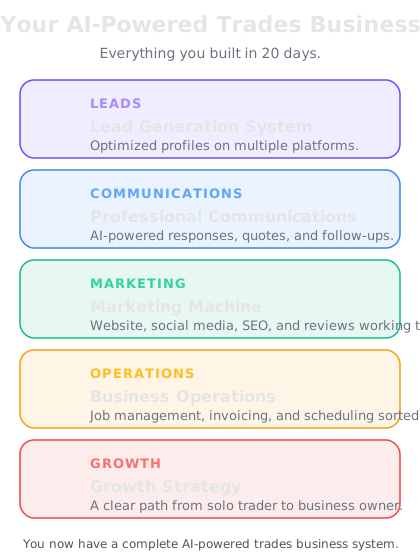
The AI-equipped tradesperson: same great skills on the tools, with a smarter business running behind them.
Final Check
What should you do first after completing this course?
A
Sign up for more courses
B
Delete your lead platform profiles and rely only on your website
C
Pick one thing you learned — updating your profile, sending follow-ups, or building your website — and do it today, because action beats knowledge every time
D
Wait for AI to improve before taking action
Knowledge without action changes nothing. The best thing you can do right now is pick the one lesson that felt most relevant to your business and implement it today. Update that profile. Send that follow-up. Build that website. Every improvement, no matter how small, starts moving the needle. The rest will follow.
🏆
Day 20 Complete
"You have the skills on the tools. Now you have the skills behind the desk. That combination is rare — and it is your biggest competitive advantage."