Day 17 of 20 · AI for Trades
Pricing Strategy with AI
⏱ 7 min
📊 Beginner
Pricing is where most tradespeople leave money on the table. Price too low and you are working long hours for thin margins. Price too high and you lose jobs to competitors. Price it right and you build a business that actually pays you what you are worth.
The problem is that most tradespeople set prices based on gut feel — what they have always charged, what their mate charges, or whatever number feels "about right." That is not a strategy. That is a guess.
AI gives you something better: data-driven pricing based on real market rates, job costs, and pricing psychology. Today you will learn how to use it.
Researching market rates with AI
Before you set a price, you need to know what the market is charging. AI can help you research this quickly.
Ask ChatGPT or Claude something like: "What are the typical rates for a full bathroom renovation in Birmingham, UK? Include labour and materials separately. Give me a range from budget to premium."
AI will pull together general market data and give you a useful starting range. It is not perfect — local rates vary — but it gives you a baseline to work from rather than guessing.
You can also cross-reference with real data. Check completed job prices on Checkatrade, look at Thumbtack's cost guides, browse hipages price ranges for your trade, or ask in trade forums. Use AI to summarise what you find: "Here are five different price ranges I found for rewiring a three-bed house. What is the average and what factors explain the differences?"
The goal is not to match the cheapest price. It is to understand where your pricing sits relative to the market so you can justify your rate with confidence.
Knowledge Check
Why should you research market rates before setting your prices?
A
Because AI knows the exact right price for every job
B
Lead platforms require you to match average rates
C
So you can always be the cheapest option
D
To understand where your pricing sits relative to competitors and set rates you can justify with confidence
Knowing the market gives you confidence. When a customer asks "Why are you more expensive than the other quote?" you can explain clearly what they get for the money — better materials, longer guarantee, more experience, included clean-up. That confidence comes from knowing your position in the market, not guessing.
Pricing psychology that wins jobs
Here are three pricing strategies that professional businesses use every day. AI can help you apply them to your trade:
Anchoring. When you present three options — Basic, Standard, and Premium — the customer mentally anchors to the highest price. Suddenly the Standard option feels like a good deal. A decorator quoting a living room might offer: Basic (walls only, £400), Standard (walls and woodwork, £650), Premium (walls, woodwork, ceiling, and prep work, £900). Most customers pick Standard.
Bundling. Combine related services into a package at a slight discount. An electrician could offer a "New Home Safety Bundle" — full inspection, smoke alarm fitting, and consumer unit check for £350 instead of £420 separately. The customer feels they are getting value. You get a bigger job.
Odd pricing. £1,975 feels meaningfully cheaper than £2,000 even though the difference is tiny. For larger jobs, pricing just under round numbers makes your quote feel more precise and calculated, like you have worked it out carefully rather than plucking a number from thin air.
I'm a builder and I've been asked to quote for a loft conversion in South London. It's a dormer conversion on a semi-detached, about 20 square metres. I want to be competitive but profitable. My costs are roughly: materials £18,000, labour (me plus one labourer for 6 weeks) £9,000, skip and waste £1,200. Can you help me price this?
**Cost breakdown:**
- Materials: £18,000
- Labour: £9,000
- Skip/waste: £1,200
- **Total cost: £28,200**
**Market context:**
Dormer loft conversions in South London typically range from £38,000 to £55,000 depending on spec and finish. A 20sqm dormer on a semi-detached sits in the middle of the market.
**Recommended tiered pricing:**
**Standard Package — £42,500**
Includes: structural work, dormer build, plastering, electrics, standard window, staircase, and building regs sign-off. Customer arranges own decoration.
**Premium Package — £48,750**
Everything in Standard, plus: Velux window upgrade, en-suite rough-in (plumbing ready for shower room), full decoration, and 2-year workmanship guarantee.
**Your margins:**
- Standard: £42,500 - £28,200 = **£14,300 profit (33.6%)**
- Premium: Additional materials ~£3,500 = **£17,050 profit (34.9%)**
**Why this works:**
- Both options are within market range
- The Premium anchors high, making Standard feel reasonable
- 33-35% margin accounts for contingency and profit
- Pricing at £42,500 (not £42,000) suggests precision
**Tip:** Present both options in a written quote. Most customers will choose Standard, but some will upgrade — and you earn more for relatively little extra work.
↻ Replay conversation
Per job vs per day vs per hour
Choosing the right pricing model depends on the type of work:
Per job (fixed price) works best for defined projects where you can accurately estimate the scope — a bathroom refit, a boiler install, a garden landscaping project. Customers love fixed prices because there are no surprises. You benefit because efficiency means higher hourly earnings. The risk is underquoting, so build in a contingency.
Day rate suits ongoing or less defined work — general building work, maintenance contracts, larger renovation projects where the scope might shift. A day rate protects you from scope creep. Make sure customers understand what a "day" means — typically 8 hours on site.
Hourly rate is best for small repair jobs, callouts, and diagnostic work. An emergency plumber charging a callout fee plus an hourly rate is standard. Keep your minimum charge high enough to make short jobs worthwhile — nobody profits from a 30-minute job with an hour of travel each way.
Ask AI to help you calculate: "If my day rate is £250 and a bathroom refit takes me 8 days, but I could quote it as a fixed price job for £2,400, which is more profitable after materials?" AI will run the numbers and show you which model puts more money in your pocket.
Knowledge Check
When should a tradesperson use fixed-price quoting instead of a day rate?
A
Always, for every type of job
B
Never — day rates are always safer
C
For well-defined projects where the scope is clear — like a boiler install or bathroom refit — because efficiency rewards you with a higher effective hourly rate
D
Only for jobs under £500
Fixed pricing works when you know the scope. If you can fit a boiler in six hours but quote a fair fixed price, your effective hourly rate is excellent. The risk is underquoting, so always build in contingency. For jobs where the scope is uncertain, a day rate protects you from surprises.
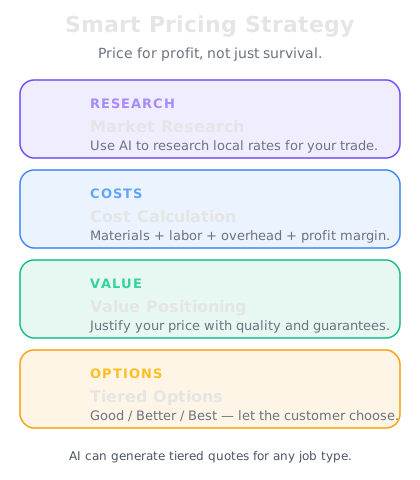
Tiered pricing uses anchoring psychology to guide customers toward your most profitable option.
Final Check
What is the purpose of presenting a "Premium" option in a tiered quote?
A
To trick customers into overpaying
B
Because you should always push the most expensive option
C
Premium options are required by consumer protection laws
D
It anchors the customer's perception of value — making the Standard option feel like a reasonable deal by comparison
Anchoring is not deception — it is presentation. When customers see three clear options, they can make an informed choice. The Premium option sets the ceiling, making the Standard option feel sensible. Most customers pick the middle. Some pick Premium. Either way, you earn more than offering a single take-it-or-leave-it price.
💷
Day 17 Complete
"Stop guessing your prices. Use AI to research the market, calculate your margins, and present tiered options that guide customers toward the right choice."
Tomorrow — Day 18
Managing Multiple Jobs
Tomorrow you'll learn how AI can help you organise your schedule, track jobs, and stop things falling through the cracks.