Differentiated Resources Without the Overtime
This is one of the most important lessons in this entire course. If you take only one skill away from these 20 days, let it be this one.
Differentiation is what turns good teaching into great teaching. It's also what turns a reasonable evening into a late night. Creating the same resource at three levels, adapting worksheets for EAL learners, scaffolding tasks for students with SEND — this is work that matters deeply and takes forever.
AI changes the equation completely. Today you'll learn to generate one prompt and get three levelled worksheets, scaffolded appropriately, with EAL support built in. In about two minutes.
Why differentiation takes so long
Let's acknowledge the reality. When you differentiate a resource manually, you're essentially creating three versions of the same thing:
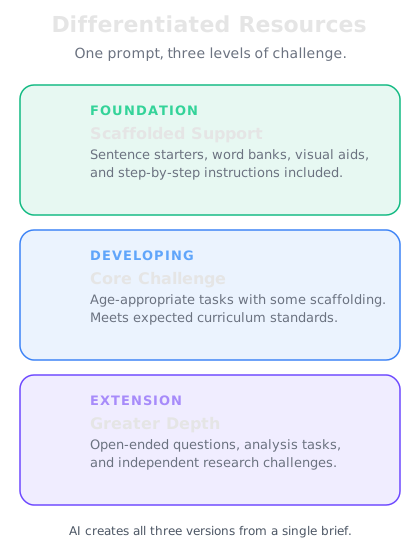
Foundation level — Simplified language, sentence starters, word banks, visual supports, reduced number of questions, scaffolded steps.
Core level — Standard expectations for the year group. Clear instructions, appropriate challenge, some independence expected.
Extension level — Higher-order thinking, open-ended questions, less scaffolding, connections to wider concepts, greater independence.
Each version takes 20 to 30 minutes to create. That's an hour for one topic. Multiply by five subjects a day in primary, or five classes a day in secondary, and you can see why teachers' workload is unsustainable.
The frustrating part is that the thinking is the same across all three levels. The core content doesn't change. What changes is the scaffolding, the language complexity, and the level of support. And that's exactly the kind of pattern AI excels at.
The one-prompt differentiation method
Here's the prompt template that changes everything. One prompt, three levels:
"Create a worksheet on [topic] for [year group/grade] [subject]. Produce three versions:
Foundation: [X] questions. Use simplified language. Include sentence starters for written responses. Provide a word bank with key vocabulary and definitions. Include visual supports where appropriate. Break multi-step problems into guided steps. Suitable for students working below age-related expectations.
Core: [X] questions. Standard language for the year group. Mix of short-answer and explanation questions. Some scaffolding but increasing independence. Suitable for students working at age-related expectations.
Extension: [X] questions. Include higher-order thinking — analyse, evaluate, create. Open-ended questions with no single correct answer. Minimal scaffolding. Connections to wider concepts. Suitable for students working above age-related expectations.
All three versions should cover the same core content and learning objective: [state the objective]. Format each as a clear, print-ready worksheet with a title and instructions."
That single prompt replaces an hour of differentiation work.
Scaffolding that actually works
The key to good differentiation isn't just making things "easier" or "harder." It's about providing the right level of scaffolding — the temporary supports that help students access the learning.
When you use AI for differentiation, be specific about the type of scaffolding you want:
Sentence starters — "The author uses this technique to..." or "One difference between X and Y is..."
Worked examples — Show the first question completed, with annotations explaining each step.
Visual organisers — Tables, Venn diagrams, flow charts, or sequencing frames that structure thinking.
Word banks — Key vocabulary with simple definitions, ideally with visual cues.
Reduced cognitive load — Fewer questions, simpler multi-step problems broken into parts, one instruction at a time.
Modelled answers — Show what a good answer looks like so students can see the target.
You can ask for any combination of these in your prompt. The more specific you are about the scaffolding, the more useful the output.
EAL-friendly versions
For students with English as an Additional Language, the challenge isn't the content — it's the language surrounding it. AI can generate EAL-adapted versions with specific modifications:
"Adapt this worksheet for EAL students at an early acquisition stage. Simplify all instructions to short, clear sentences. Replace idioms and complex vocabulary with plain language. Add visual cues alongside key terms. Include a bilingual glossary box with space for students to write translations in their home language. Use numbered steps for all multi-part instructions."
You can also ask for specific language support: "Include key vocabulary in English and [language] if possible." AI handles major languages well and can provide side-by-side vocabulary lists that help EAL students access the same content as their peers.
The critical thing is that EAL adaptation is about language access, not about reducing the intellectual challenge. An EAL student in Year 9 might be working at a high academic level in their home language — they need language scaffolding, not simpler maths.
SEND adaptations
For students with Special Educational Needs and Disabilities, AI can generate targeted adaptations. Be specific about the need:
For dyslexia: "Format with increased line spacing, dyslexia-friendly font suggestions (e.g., OpenDyslexic or Arial), shorter lines of text, and avoid dense paragraphs. Use bullet points instead of continuous prose."
For ADHD: "Break the worksheet into clearly separated sections with visual dividers. Include a progress checklist. Limit each section to 3-4 questions maximum. Add a 'brain break' prompt halfway through."
For visual processing difficulties: "Use high contrast formatting, larger font size, generous white space. Avoid cluttered layouts. One question per section with clear boundaries."
For autism spectrum: "Use precise, unambiguous language. Avoid figurative language, sarcasm, or open-ended instructions without frameworks. Provide a clear structure with numbered steps and explicit expectations for each answer."
Remember: never put student names or identifiable information into AI tools. Describe the need generically and apply the adaptations yourself.
Building your differentiation prompt library
You're going to differentiate every week for the rest of your career. So let's make it efficient. Create a simple document — a Google Doc, a note on your phone, whatever works — with these saved prompts:
Three-level worksheet prompt — The template from earlier in this lesson. Customise it for your most common subjects and year groups.
EAL adaptation prompt — Your go-to prompt for creating language-accessible versions.
SEND adaptation prompts — One for each common need in your classes.
Quick differentiation prompt — "Take this [task/question/activity] and create a scaffolded version with sentence starters and a word bank, and an extension version with higher-order thinking questions."
Save these somewhere you can access quickly. Over time, you'll build a library of prompts that let you differentiate any resource in under two minutes. That's not a teaching hack — that's a sustainable practice that makes differentiation genuinely achievable every single lesson.