Day 10 of 20 · AI for Sales
Proposals That Close Deals
⏱ 7 min
📊 Beginner
You've done the discovery. You know their pain. You've handled the objections. Now it's time to send the proposal — and here's where most reps lose momentum.
The average B2B sales proposal takes 3-4 hours to write. That's half a day gone on a single deal. And because it takes so long, reps either rush it (producing generic garbage) or procrastinate (losing deal momentum). Both cost you money.
What if you could turn your discovery notes into a polished, personalised proposal in 15-20 minutes? Today you'll learn exactly how — and why AI-generated proposals actually outperform the ones you used to spend all day writing.
The anatomy of a winning proposal
Before we touch AI, let's agree on what a great proposal looks like. The best proposals aren't product brochures — they're documents that say "I heard you, I understand your problem, and here's exactly how we'll fix it."
Every winning proposal has seven sections:
Executive summary — Two paragraphs that prove you listened during discovery. Reference their specific pain points, not generic industry problems.
Problem statement — Their world without your solution. Quantify the cost of inaction. Make it hurt (a little).
Proposed solution — How your product solves their specific problem. Not a feature list — a narrative that connects features to their pain.
ROI calculation — Hard numbers. What will they save? What will they gain? Show your math.
Timeline and implementation — When does this happen? What are the phases? Who does what?
Pricing — Clear, simple, tied back to value. No surprises.
Next steps — The exact action they need to take, with a date.
Knowledge Check
What's the most important difference between a winning proposal and a generic one?
A
A winning proposal references the prospect's specific pain points from discovery — proving you listened and tailored the solution to them
B
A winning proposal includes every product feature available
C
A winning proposal has more pages and more detail
D
A winning proposal uses better design and formatting
When a prospect opens your proposal and sees their exact words reflected back — the pain they described, the goals they mentioned, the timeline they shared — they feel understood. A generic proposal with "companies like yours" and boilerplate benefit statements feels like you sent the same document to everyone. Personalisation is the difference.
The before and after
Let's see the difference AI makes. Here's a typical proposal opening written by a rushed rep:
"Thank you for your interest in CloudSecure. We are a leading provider of cloud security solutions, serving over 500 enterprise clients worldwide. Our platform provides comprehensive protection against cyber threats, ensuring your organization stays secure and compliant."
Now here's what AI generates when you feed it your discovery notes:
"During our conversation on March 12th, you shared that Meridian Health's move to AWS last quarter exposed gaps in your HIPAA compliance monitoring — specifically, your team is manually auditing access logs across 14 cloud instances, consuming roughly 20 hours per week. With two compliance audits scheduled this year and your security team already stretched thin, the risk isn't theoretical. Here's how CloudSecure eliminates that gap."
Same company, same product. But the second version makes the prospect feel like the proposal was written for them — because it was.
Turning discovery notes into proposals
Here's the prompt template that makes this work. This is the single most valuable prompt in your sales toolkit:
"I just finished a discovery call. Here are my raw notes: [paste notes]. Using these notes, write a B2B proposal with the following sections: (1) Executive Summary — 2 paragraphs referencing their specific pain points, (2) Problem Statement — quantify the cost of their current situation, (3) Proposed Solution — connect our product features to their specific problems, (4) ROI Calculation — estimate savings and gains with clear math, (5) Timeline — 90-day implementation plan, (6) Pricing — present [your pricing] tied to value, (7) Next Steps — specific action items with dates. Our product is [brief description]. Tone: confident, consultative, no jargon."
Let's see this in action with a real deal.
Here are my discovery notes from a call with Jennifer Park, Director of Operations at FastTrack Logistics (800 employees, $120M revenue):
- Currently using 4 disconnected systems for fleet management, routing, dispatch, and driver comms
- Dispatchers waste 2+ hours daily on manual route optimization
- Lost 3 enterprise clients last quarter due to late deliveries ($2.1M in annual revenue)
- Jennifer needs board approval — presenting to CFO and CEO in 3 weeks
- Budget: $200-250K range, wants ROI within 6 months
- Competitor: looked at FleetPro but concerned about implementation timeline
- Key priority: real-time visibility into fleet status
Write a proposal for our unified logistics platform ($220K/year). Include all 7 sections.
# Proposal: Unified Logistics Platform for FastTrack Logistics
## Executive Summary
FastTrack Logistics has built a strong reputation in the logistics industry, growing to $120M in revenue by delivering reliably for enterprise clients. But that reliability is under pressure. Your operations team is managing fleet operations across four disconnected systems, creating manual bottlenecks that cost time, accuracy, and — most critically — client relationships. The loss of three enterprise accounts last quarter, representing $2.1M in annual revenue, signals that the current infrastructure can't keep pace with FastTrack's growth.
This proposal outlines how our unified logistics platform eliminates those gaps — consolidating fleet management, routing, dispatch, and driver communications into a single system with real-time visibility. Based on your team's current challenges, we project $3.2M in recoverable value within the first 12 months.
## Problem Statement
FastTrack's operations team currently operates across four disconnected platforms. The measurable cost:
- **Route optimization**: Dispatchers spend 2+ hours daily on manual routing — that's 520+ hours annually per dispatcher, at an estimated cost of $45,000/year in labor inefficiency
- **Client attrition**: Three enterprise clients lost last quarter due to late deliveries = $2.1M in recurring annual revenue lost
- **No real-time visibility**: Without a unified view of fleet status, exceptions are caught late and escalated reactively instead of prevented proactively
- **Estimated total annual cost of current state: $3.2M+**
## Proposed Solution
Our unified logistics platform replaces your four disconnected systems with a single platform:
- **Automated route optimization** — AI-powered routing reduces dispatcher manual work by 80%, cutting daily route planning from 2+ hours to under 25 minutes
- **Real-time fleet visibility** — Live dashboards showing every vehicle, every delivery, every exception — the exact capability Jennifer identified as the top priority
- **Unified dispatch and driver communication** — One system for assignments, updates, and alerts — no more toggling between platforms
- **Predictive delay alerts** — Flag at-risk deliveries before they become late, giving your team time to intervene and protect client relationships
## ROI Calculation
| Category | Annual Value |
|---|---|
| Recovered client revenue (prevent future attrition) | $2,100,000 |
| Dispatcher efficiency gains (520+ hours/year saved) | $180,000 |
| Fuel savings from optimized routing (est. 12% reduction) | $340,000 |
| Reduced exception handling and escalation costs | $95,000 |
| **Total projected annual value** | **$2,715,000** |
| Platform investment | $220,000/year |
| **Net ROI** | **$2,495,000 (12.3x return)** |
## Timeline
- **Weeks 1-2**: Platform configuration, data migration from existing systems
- **Weeks 3-4**: Pilot deployment with one dispatch team (20 vehicles)
- **Weeks 5-8**: Full fleet rollout with training
- **Weeks 9-12**: Optimization, reporting setup, executive dashboard
- **Month 4-6**: ROI measurement period
## Pricing
Unified Logistics Platform: **$220,000/year** (within stated $200-250K budget range). This includes implementation, training, and dedicated success manager for the first 12 months.
## Next Steps
1. Jennifer reviews this proposal — by March 25th
2. We prepare a CFO-ready ROI deck for the board presentation — by March 28th
3. Board presentation — week of April 7th
4. If approved, kickoff call — week of April 14th
Want me to also draft the CFO-ready executive deck for Jennifer's board presentation?
↻ Replay conversation
Knowledge Check
Why does the ROI section present specific dollar amounts rather than percentages or vague "significant savings"?
A
Specific numbers are always more accurate than estimates
B
Percentages are harder to calculate with AI
C
Dollar amounts look more impressive in proposals
D
CFOs and decision-makers need concrete numbers to justify the investment internally — specific figures make the business case defensible
When Jennifer walks into the board meeting, the CFO won't be impressed by "significant savings." But "$2.7M in annual value against a $220K investment — that's a 12x return" gives the CFO something to defend. Specific numbers, with clear math showing how you got there, make your proposal a tool the champion can use to sell internally.
Customising for the decision-maker
A proposal for a Director of Operations looks different from a proposal for a CFO. AI lets you create multiple versions targeting different stakeholders — without rewriting from scratch.
For the operational buyer (Director, VP of Ops): Lead with efficiency gains, workflow improvements, and team impact. They care about how this makes their life easier.
For the financial buyer (CFO, Finance): Lead with ROI, cost reduction, and payback period. They care about the numbers.
For the technical buyer (CTO, IT): Lead with architecture, integrations, security, and scalability. They care about how this fits into the existing stack.
For the executive sponsor (CEO, COO): Lead with strategic impact, competitive advantage, and company-wide transformation. They care about the big picture.
Use this prompt: "Rewrite the executive summary of this proposal for a [CFO] audience. Emphasise [ROI, payback period, and risk reduction]. Keep it under 200 words."
One set of discovery notes, four versions of the proposal, each speaking the language that resonates with that buyer.
The proposal review checklist
Before you send any AI-generated proposal, run it through this checklist:
Accuracy check — Are all numbers correct? Did AI make up any statistics? Verify every dollar figure and percentage.
Personalisation check — Does the proposal reference at least 3 specific things from your discovery call? Names, dates, problems, quotes?
Tone check — Does it sound like you, or does it sound like a robot? Read the executive summary out loud. If it doesn't sound like something you'd say in person, rewrite it.
Competition check — If the prospect mentioned a competitor, does your proposal address why you're different without being negative?
Next steps check — Is the call to action specific and time-bound? "Let's discuss" is weak. "Let's schedule a 30-minute review on Thursday" is strong.
This review takes 5 minutes and is the difference between sending a good proposal and a great one.
Knowledge Check
What's the most critical item to verify before sending an AI-generated proposal?
A
Accuracy of all numbers — AI can fabricate statistics and calculations, so every dollar figure and percentage must be manually verified
B
That the AI disclaimer is included at the bottom
C
The font and formatting of the document
D
Whether the proposal is long enough
AI is remarkably good at generating plausible-sounding numbers that are completely made up. If your proposal says "companies in your industry see a 34% reduction in operational costs" and the prospect asks where that number came from, you need a real answer. Always verify statistics, calculations, and any specific claims before the proposal leaves your desk.
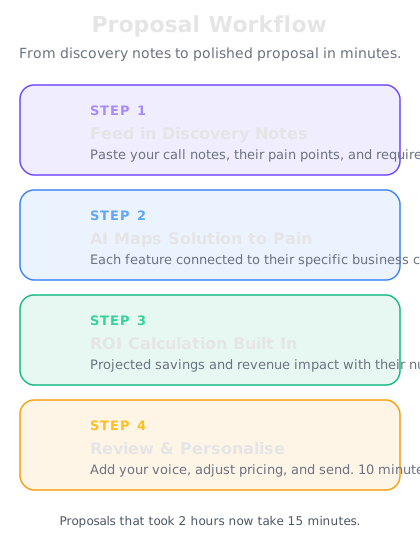
The old way versus the new way — same quality proposal, a fraction of the time. The hours you save go back into selling.
From 3 hours to 15 minutes
Let's be real about the impact. If you're writing 3-4 proposals per week and each one used to take 3-4 hours, that's 9-16 hours per week on proposal writing. At 15-20 minutes per proposal with AI, you've just freed up 8-15 hours per week.
That's not a small efficiency gain. That's an entire extra selling day every week. More calls, more meetings, more pipeline — because you're not chained to a Word document.
And here's the kicker: the AI-assisted proposals are typically better because they're more personalised, more data-driven, and more structured than what most reps produce under time pressure. You're not trading quality for speed. You're getting both.
💰
Day 10 Complete
"The best proposal isn't the longest or the prettiest — it's the one that makes the prospect feel like you built it specifically for them. AI makes that possible for every deal."
Tomorrow — Day 11
Follow-Up Sequences That Convert
Tomorrow you'll build multi-touch follow-up sequences that keep deals moving without being pushy.