Day 15 of 20 · AI for Sales
Pipeline Reviews & Forecasting
⏱ 7 min
📊 Beginner
Pipeline reviews are supposed to be the most important meeting of the week. In reality, they're usually the most painful. You spend 45 minutes going deal-by-deal while your manager asks "what's changed?" and you scramble to remember which prospect ghosted you and which one is actually moving forward.
AI changes pipeline reviews from a memory test into a strategic conversation. Today you'll learn to feed your pipeline data into AI and get deal risk analysis, forecasting insights, and recommended actions — all before the meeting even starts.
Why pipeline reviews fail
Most pipeline reviews are broken for the same reason: reps show up with vibes, not data.
The status quo is painful. You open your CRM, scroll through 30+ opportunities, and try to remember the last conversation on each one. Half your notes are outdated. Your stage definitions are inconsistent. And your manager is asking for a commit number you're not confident in.
The forecast is fiction. Most sales forecasts are built on gut feel. Reps inflate deals they're optimistic about and hide deals that are slipping. Managers layer their own adjustments on top. By the time the number reaches leadership, it's been through three rounds of creative accounting.
The actions are vague. "Follow up next week" isn't a strategy. Neither is "waiting for the champion to get back to me." Without clear next steps tied to deal risk, pipeline reviews become status updates instead of strategy sessions.
AI fixes all three problems. It reads the actual data, identifies real risk patterns, and recommends specific actions — no vibes required.
Knowledge Check
What is the core problem with most pipeline reviews?
A
Reps rely on memory and gut feel instead of data-driven analysis — leading to inaccurate forecasts and vague action plans
B
Pipeline reviews happen too frequently
C
Managers ask too many questions during the review
D
CRM software is too difficult to navigate
The fundamental issue is the gap between what's in the CRM and what's in the rep's head. AI closes that gap by analyzing actual deal data — activity logs, email patterns, timeline changes — and surfacing patterns that humans miss when they're managing 30+ deals simultaneously.
Feeding your pipeline into AI
The process is straightforward. You export your pipeline data from your CRM (or simply copy-paste it) and let AI do the heavy lifting.
Here's what to include when you feed your pipeline to AI:
Deal basics — Name, stage, amount, close date, days in current stage.
Activity data — Last contact date, number of emails sent/received, meetings scheduled, proposal sent date.
Stakeholder info — Who's involved, their role (champion, economic buyer, blocker), last time they engaged.
Historical notes — Key objections raised, competitor mentions, any timeline changes or pushbacks.
The more context you give, the sharper the analysis. But even basic deal data produces useful insights.
Knowledge Check
Which data point is most valuable for AI deal risk analysis?
A
The deal amount — larger deals are always riskier
B
Activity data like last contact date and email engagement patterns — because silence is the strongest signal that a deal is stalling
C
The original close date — it shows when the deal was supposed to close
D
The rep's confidence level — they know their deals best
Activity data tells the truth that deal stages often hide. A deal sitting in "Negotiation" with no email replies in 12 days isn't negotiating — it's dying. AI spots these patterns across your entire pipeline simultaneously, which is nearly impossible for a human managing dozens of deals.
AI pipeline review in action
Let's see what happens when you feed a real pipeline snapshot into AI and ask for a weekly review summary.
Here's my current pipeline for this week's review with my manager. Analyze each deal for risk level and give me a summary I can walk through in 10 minutes:
1. Meridian Corp — Negotiation, $85K, close date Dec 15, last email from champion 3 days ago, legal reviewing contract, competitor (Apex) mentioned in last call
2. Brightfield Inc — Discovery, $42K, close date Jan 30, had 2 calls with VP of Ops, no economic buyer identified yet, they said "exploring options"
3. TerraWave — Proposal Sent, $120K, close date Dec 20, proposal sent 9 days ago, no response to 2 follow-ups, champion went quiet after internal reorg
4. Oakmont Group — Demo Scheduled, $55K, close date Feb 15, strong champion (Director of Sales), demo next Tuesday, 3 stakeholders confirmed
5. Pinnacle Systems — Verbal Commit, $95K, close date Dec 10, handshake deal with VP, waiting on procurement paperwork, been "almost done" for 2 weeks
**Weekly Pipeline Review Summary**
**Total Pipeline: $397K across 5 deals**
---
🔴 **HIGH RISK — TerraWave ($120K)**
Risk: Deal is likely stalled or dead. Proposal sent 9 days ago with zero response to 2 follow-ups, and champion went silent after internal reorg.
- The reorg probably changed priorities or removed your champion's authority
- Action: Stop emailing the champion. Find a new path in — reach out to someone above or adjacent to your contact. Ask directly: "I understand there have been changes internally. Is this still a priority for Q4, or should we revisit in Q1?"
- Forecast: Move to Q1 or remove from commit
🟡 **MEDIUM RISK — Pinnacle Systems ($95K)**
Risk: "Verbal commit" with procurement stuck for 2 weeks is a classic stall signal. Procurement delays often mean internal resistance you haven't seen.
- Action: Ask your VP contact to connect you directly with procurement. Offer to jump on a call to answer any questions. Say: "I want to make sure nothing on our end is slowing this down."
- Forecast: Keep in forecast but do NOT commit this deal until paper is signed
🟡 **MEDIUM RISK — Meridian Corp ($85K)**
Risk: Competitor in play and legal review can drag. However, recent champion engagement (3 days ago) is positive.
- Action: Ask champion for a legal timeline. Prepare a competitive battle card for Apex — send your champion ammunition to sell internally. Consider offering a Dec 10 signing incentive.
- Forecast: Cautiously committable if legal clears this week
🟢 **LOW RISK — Oakmont Group ($55K)**
Risk: Minimal. Strong champion, multiple stakeholders engaged, demo scheduled. This is progressing normally.
- Action: Nail the demo. Prep a custom ROI slide for each of the 3 stakeholders. Confirm decision-making timeline in the demo.
- Forecast: On track for Feb close
🟢 **LOW RISK — Brightfield Inc ($42K)**
Risk: Low but early stage. No economic buyer identified yet and "exploring options" language suggests they're shopping.
- Action: Your #1 priority is identifying the economic buyer before your next call. Ask: "Who else needs to be involved in this decision?" Map the buying committee now.
- Forecast: On track for Jan if you identify the buyer this week
---
**Your Commit Number:**
- Safe commit: $140K (Meridian + Oakmont)
- Best case: $235K (add Pinnacle if paper comes through)
- At risk: $120K (TerraWave — likely pushed to Q1)
**Top 3 Actions This Week:**
1. Find a new contact path into TerraWave — your current thread is dead
2. Get Pinnacle connected to procurement directly
3. Prep Meridian champion with Apex competitive intel
↻ Replay conversation
Identifying stuck deals
One of the most powerful things AI does is pattern matching across your pipeline. It spots deals that look healthy on the surface but are actually stuck — what experienced managers call "happy ears" deals.
Here are the patterns AI looks for:
The silent champion. Deal stage says "Negotiation" but your champion hasn't replied in 8+ days. The stage is lying.
The eternal close date. A deal that's been pushed from November to December to January. Each push felt reasonable in the moment, but the pattern says the prospect isn't prioritizing this.
The missing buyer. You're deep in discovery with someone who loves your product but can't sign a check. No economic buyer means no deal — no matter how enthusiastic the champion is.
The zombie deal. It's been in your pipeline for 90+ days with sporadic activity. Nobody wants to kill it because the deal size is big. But it's consuming time you could spend on deals that will actually close.
Ask AI to scan your pipeline for these patterns every week. It takes 30 seconds and can save you hours of chasing deals that were never going to close.
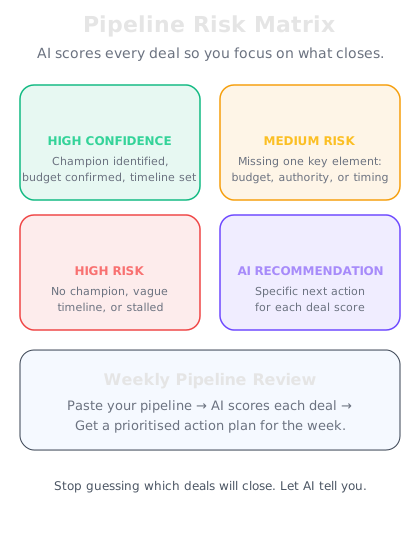
AI maps every deal on this matrix. Deals in the bottom-left quadrant need immediate attention — or removal.
Knowledge Check
What is a "zombie deal" in your pipeline?
A
A brand new deal that hasn't had its first meeting yet
B
A deal where the prospect has explicitly said no
C
A deal with a very short sales cycle
D
A deal that's been open for 90+ days with sporadic activity — nobody kills it because of the deal size, but it's consuming resources that could go to winnable deals
Zombie deals are pipeline poison. They inflate your forecast, waste your time, and give you false hope. AI identifies them by looking at the pattern — long tenure, low activity, repeated date pushes. The hardest but most valuable thing a rep can do is kill a zombie and redirect that energy to a deal with real momentum.
Building your weekly review habit
The best reps don't wait for the pipeline review meeting to analyze their deals. They run a personal AI review every Sunday evening or Monday morning. Here's the routine:
Step 1: Export your pipeline. Pull your open opportunities from your CRM. Include stage, amount, close date, last activity date, and next steps.
Step 2: Paste into AI with this prompt. "Analyze my pipeline. For each deal, rate risk as high/medium/low. Identify any deals that are stalling. Give me my top 3 priorities for this week and a realistic commit number."
Step 3: Update your CRM. Move dates, adjust stages, and add the recommended next steps as tasks.
Step 4: Walk into the review prepared. You now have a data-backed commit number, clear risk assessments, and specific actions. Your manager will notice the difference immediately.
This takes 15 minutes. It replaces the hour of scrambling most reps do before their pipeline review, and it produces dramatically better results.
Knowledge Check
When should you run your AI pipeline analysis?
A
Only when your manager asks for a forecast
B
Before the pipeline review meeting — ideally Sunday evening or Monday morning — so you walk in with data-backed insights and a clear plan
C
At the end of the quarter when forecasting matters most
D
After the pipeline review to check if your manager was right
The reps who win run their analysis before the meeting, not during it. When you walk into a review with risk-rated deals, specific actions, and a realistic commit number, you look like the most prepared person in the room — because you are. AI did the analysis; you get the credit.
💰
Day 15 Complete
"Stop showing up to pipeline reviews with vibes. Feed your data to AI and show up with a plan your manager wishes every rep had."
Tomorrow — Day 16
Account Plans & Strategies
Tomorrow you'll build strategic account plans that turn good accounts into great ones — with AI doing the heavy lifting.