Day 8 of 20 · AI for Sales
Discovery Call Mastery
⏱ 7 min
📊 Beginner
The best sales reps don't wing discovery calls. They walk in with a game plan — the right questions, in the right order, tailored to the exact person sitting across the table.
The problem? Building that question list used to take 30-60 minutes of research per prospect. Understanding their industry, mapping their org chart, identifying likely pain points — it's real work. Most reps skip it entirely and default to a generic question list that sounds like every other vendor call.
AI changes this completely. Today you'll learn to generate industry-specific, persona-tailored discovery questions in minutes — plus pre-call prep briefs and post-call summaries that keep your pipeline moving.
Why discovery separates closers from quota-missers
Here's the uncomfortable truth: discovery is where deals are won or lost, not in the demo, not in the proposal, not in the negotiation. A bad discovery call means you're pitching features they don't care about to a person who can't sign the check.
Great discovery achieves three things:
Uncovers the real pain — Not the polished version they give every vendor, but the actual problem keeping them up at night.
Qualifies the opportunity — Is there budget? A timeline? A decision-maker? If not, you need to know now, not three months into the deal.
Builds trust — When you ask questions that show you understand their world, the prospect stops seeing you as a vendor and starts seeing you as a partner.
AI helps you nail all three by doing the research homework that most reps skip.
Knowledge Check
Why is the discovery call considered the most critical stage of the sales process?
A
Because it's the longest meeting in the sales cycle
B
Because decision-makers only attend discovery calls
C
Because it's the first time you get to present your product's features
D
Because it's where you uncover real pain, qualify the opportunity, and build trust — everything else depends on what you learn here
The discovery call sets the foundation for the entire deal. If you uncover the wrong pain point, your proposal misses the mark. If you fail to qualify, you waste months chasing a dead deal. If you don't build trust, they ghost you after the demo. Everything downstream depends on getting discovery right.
Frameworks that actually work
You've probably heard of BANT, MEDDIC, and SPIN. These frameworks are powerful — but most reps use them like a checklist, asking robotic questions that make prospects feel interrogated.
The trick is turning framework questions into natural conversation starters:
BANT (Budget, Authority, Need, Timeline) — Instead of "What's your budget?" try "How are you thinking about the investment for this initiative?" Same information, completely different energy.
MEDDIC (Metrics, Economic Buyer, Decision Criteria, Decision Process, Identify Pain, Champion) — Instead of "Who's the decision-maker?" try "Walk me through what happens after you decide this is the right solution — who else weighs in?"
SPIN (Situation, Problem, Implication, Need-Payoff) — Instead of "What problems are you facing?" try "What's changed in the last 6 months that made this a priority now?"
AI can take any framework and generate questions that sound like a conversation, not an interrogation.
Knowledge Check
What's the biggest problem with using sales frameworks like BANT or MEDDIC as rigid checklists?
A
Prospects have been trained to recognize these frameworks
B
The frameworks are outdated and no longer relevant
C
Frameworks limit the number of questions you can ask
D
The questions sound robotic and make prospects feel interrogated rather than understood — killing trust in the process
Frameworks are guides, not scripts. When you ask "What's your budget?" it sounds like you're filling out a form. When you ask "How are you thinking about the investment?" you're having a conversation. The information you get back is the same — but the relationship you build while getting it is completely different.
AI-generated discovery questions by industry
Here's where AI becomes your secret weapon. Instead of using the same 10 questions for every call, you can generate questions tailored to the prospect's industry, company size, and role — in seconds.
The key is giving AI enough context to be specific. Compare these two prompts:
Weak: "Give me discovery questions for a sales call."
Strong: "I'm selling [product] to a [role] at a [company size] [industry] company. They likely care about [2-3 priorities]. Generate 10 discovery questions using the MEDDIC framework that sound natural and conversational — not like a checklist."
The difference in output quality is massive. Specificity is everything.
I'm an AE at a cloud security company. Tomorrow I have a discovery call with the VP of IT at a 500-person healthcare company. We sell a $200K/year cloud security platform. They reached out after a competitor had a data breach.
Generate 12 discovery questions using MEDDIC framework. Make them sound natural and conversational — not like a checklist. Group them by the MEDDIC categories.
Here are your discovery questions, grouped by MEDDIC:
**Metrics (What does success look like?)**
1. "When you picture this project being a success 12 months from now — what's different? What numbers would you point to?"
2. "How are you currently measuring your security posture? Are there specific compliance benchmarks you're being held to?"
**Economic Buyer (Who signs the check?)**
3. "Beyond your team, who else has a stake in this decision? I want to make sure we're building a case that resonates with everyone involved."
4. "When a project like this gets budget approval, what does that process typically look like at your organization?"
**Decision Criteria (How will they choose?)**
5. "If you're evaluating a few options, what are the three things that would make you say 'that's the one'?"
6. "How important is healthcare-specific compliance — HIPAA, HITRUST — versus general security capabilities in your evaluation?"
**Decision Process (What's the buying journey?)**
7. "Walk me through what happens after you decide a solution is the right fit — what are the steps between 'we like it' and 'it's live'?"
8. "Is there a timeline driving this? I'm guessing the recent breach news has added some urgency internally."
**Identify Pain (What's broken?)**
9. "What prompted you to look at this now — was it purely the competitor breach, or were there internal conversations happening before that?"
10. "Where do you feel most exposed today? If you could fix one security gap overnight, what would it be?"
**Champion (Who's fighting for you internally?)**
11. "It sounds like you're the one driving this — is that right? Who else on your team is passionate about getting this solved?"
12. "If we can prove this is the right fit, would you be comfortable being the person who champions this through the approval process?"
**Bonus — Opener to set the tone:**
"Before I dive in, I'd love to hear what made you reach out. Sometimes it's one specific thing, sometimes it's been building for a while — what's the story on your end?"
↻ Replay conversation
Pre-call prep in 60 seconds
Beyond discovery questions, AI can build you a complete pre-call brief. This is the research that elite reps do before every meeting — compressed from 30 minutes into 60 seconds.
Here's the prompt template:
"I have a discovery call with [Name], [Title] at [Company]. Research this company and role. Give me: (1) Company overview in 3 bullet points, (2) Recent news or events that might be relevant, (3) Likely priorities for this role, (4) Potential pain points I should explore, (5) A suggested opening line that references something specific about them."
You can paste in their LinkedIn profile, company website, or recent press releases for even better results. The more context you give AI, the sharper the output.
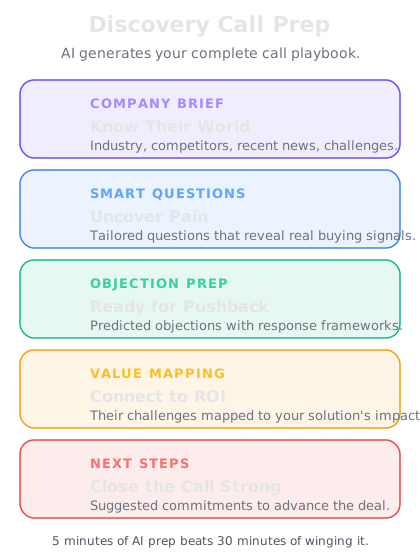
The AI-powered pre-call prep workflow — research, generate, review, execute. What used to take 30 minutes now takes 3.
Post-call summaries that keep deals moving
The call is over. Now what? Most reps jot down a few notes and move on. The best reps create a structured summary that drives the next step.
Here's a post-call prompt template that turns rough notes into a deal-advancing document:
"Here are my raw notes from a discovery call with [Name] at [Company]: [paste notes]. Turn these into a structured summary with: (1) Key pain points uncovered, (2) Decision-making process, (3) Budget and timeline, (4) Next steps and owners, (5) Red flags or risks, (6) Recommended follow-up email draft."
This summary becomes your CRM entry, your manager update, your follow-up email draft, and your proposal foundation — all from one prompt. You'll never lose critical deal intelligence again.
Knowledge Check
Why is a structured post-call summary more valuable than quick notes?
A
Structured summaries are easier to share on social media
B
It makes your notes look more professional
C
Managers require structured summaries for every call
D
It captures deal intelligence in a format that drives next steps, updates the CRM, and informs your proposal — instead of sitting in a forgotten notebook
Raw notes like "they care about compliance, budget is TBD, follow up next week" don't move deals forward. A structured summary with specific pain points, decision criteria, and a drafted follow-up email turns a conversation into momentum. It's the difference between knowing what happened and knowing what to do next.
Putting it all together
Here's your discovery call workflow with AI:
Before the call (3 minutes): Generate a pre-call brief and tailored discovery questions. Review them while your coffee cools.
During the call (30-60 minutes): Use the questions as a guide, not a script. Listen more than you talk. Jot rough notes.
After the call (2 minutes): Paste your rough notes into AI. Get a structured summary, CRM entry, and follow-up email draft.
Total AI time: 5 minutes. Total value: the difference between a call that goes somewhere and a call that goes nowhere.
The reps who prepare like this don't just hit quota — they crush it. Because when you walk into every call with better questions than the other three vendors on the shortlist, you stand out immediately.
Knowledge Check
What's the recommended total AI time investment for the full discovery call workflow (before, during, and after)?
A
Zero minutes during the call — AI should only be used after the call ends
B
About 30 minutes — you need to carefully edit every AI-generated question
C
About 5 minutes total — 3 minutes for pre-call prep and 2 minutes for the post-call summary
D
About 15 minutes — you need to generate multiple versions of everything
The beauty of this workflow is efficiency. Three minutes before the call gives you a pre-call brief and tailored questions. Two minutes after the call gives you a structured summary and follow-up email. The call itself is all you — listening, asking, building rapport. AI handles the prep and the paperwork.
💰
Day 8 Complete
"Walk into every discovery call with better questions than the other three vendors on the shortlist — and you'll be the one they remember."
Tomorrow — Day 9
Objection Handling — AI Role Play
Tomorrow is unique — you'll use AI as a practice partner to rehearse handling real objections from tough buyers.