Cold Emails That Get Opened
The average B2B decision-maker receives 120+ emails per day. Your cold email is competing with internal fires, board updates, customer escalations, and 30 other sales reps who are all opening with "I hope this email finds you well."
Most cold emails get deleted in under 2 seconds. But the best ones — the ones that get opened, read, and replied to — follow a specific formula. And AI can help you write them at scale without sacrificing personalization.
Today you'll learn the anatomy of a high-response cold email and how to use AI to generate personalized sequences that actually land.
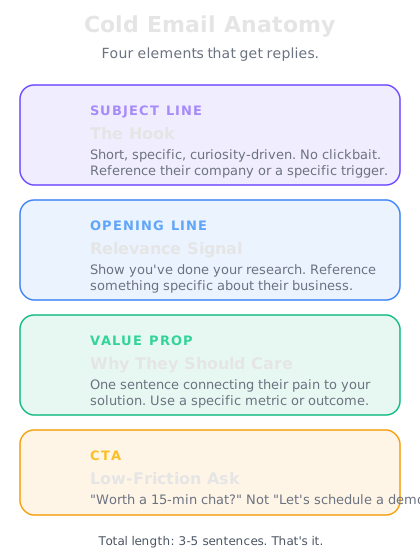
The anatomy of a cold email that gets replies
Every cold email that consistently drives responses has four elements. Miss any one of them and your email dies in the inbox:
1. Subject line (3-7 words) — This is your ad headline. It needs to create curiosity or signal relevance without being clickbait. The subject line determines whether your email gets opened at all.
Good examples:
- "Quick question about [specific initiative]"
- "[Mutual connection] suggested I reach out"
- "[Company]'s expansion to EMEA"
- "Idea for [specific pain point]"
2. Personal hook (1-2 sentences) — Prove you're not blasting a template to 500 people. Reference something specific: a recent funding round, a LinkedIn post they wrote, a job posting that signals a pain point, a company milestone.
3. Value proposition (2-3 sentences) — What's in it for them? Not a feature dump. A specific outcome tied to their world. "We help companies like [similar company] reduce [specific metric] by [percentage]" is 10x better than "Our platform provides end-to-end solutions."
4. Call-to-action (1 sentence) — One clear, low-friction ask. Not "Let me know your thoughts." Instead: "Worth a 15-minute call on Thursday or Friday?" Give them something specific to say yes to.
The AI cold email prompt
Here's the prompt that generates cold emails worth sending. Feed it the research you gathered yesterday:
```
Write a cold email to [NAME], [TITLE] at [COMPANY].
Context about them:
- [Paste 3-4 bullet points from your Perplexity research]
What I sell:
- [Your product/service and the specific problem it solves]
Relevant proof point:
- [A result you've gotten for a similar company]
Rules:
- Subject line: 3-7 words, no clickbait
- Total email length: under 125 words
- Opening line must reference something specific about them or their company
- Value prop must be tied to their likely pain point
- CTA: one specific, low-friction ask (suggest 2 time slots)
- Tone: professional but human, not salesy
- No "I hope this finds you well" or "My name is..."
```
The key is in the "Rules" section. Without constraints, AI will write a 300-word, generic sales essay. The rules force it to write the tight, personalized emails that actually get responses.
Personalization at scale — the real superpower
Here's where AI transforms your outreach game. The traditional tradeoff in sales has always been:
High personalization = high response rate but low volume (you can only manually personalize 15-20 emails per day)
High volume = low response rate but more total conversations (you blast templates to 200 people and hope for the best)
AI breaks this tradeoff. Here's how:
Step 1: Batch-research 10 prospects using Perplexity (Day 3 technique). Takes 15-20 minutes.
Step 2: Feed each research briefing into ChatGPT with the cold email prompt. Generate 10 personalized emails in 10-15 minutes.
Step 3: Review and edit each email. Add your personal touch, adjust the tone, make it sound like you. Takes 10-15 minutes.
Total: 10 genuinely personalized cold emails in 40-50 minutes. That's a volume you could previously only achieve with templates, but at a quality level that used to require 20+ minutes per email.
Reps using this system consistently see 3-5x improvement in reply rates compared to template-based outreach.
Building a 3-email sequence
One email rarely gets the job done. The money is in the follow-up sequence. Here's a proven 3-email structure:
Email 1 (Day 0) — The Value Open
Lead with their world. Reference something specific. Offer a relevant insight or result. Ask for 15 minutes.
Email 2 (Day 3) — The Proof Point
Short. Reference your first email. Add a case study, stat, or specific result that's relevant to their situation. Same CTA, different angle.
Email 3 (Day 7) — The Breakup
Acknowledge they're busy. Offer value with no strings (a relevant article, benchmark, or insight). Close with a soft CTA. "If the timing isn't right, no worries — happy to reconnect next quarter."
The breakup email often gets the highest response rate because it removes pressure and creates FOMO.
A/B testing with AI
One of the most underused AI sales tactics: generating multiple versions and testing them.
Here's the prompt:
```
Give me 3 different versions of a cold email to [PROSPECT].
- Version A: Lead with a pain point
- Version B: Lead with a competitor comparison
- Version C: Lead with a provocative question
Same structure, same CTA, different opening angles. Keep each under 125 words.
```
Send Version A to one-third of your list, Version B to another third, and Version C to the last third. After 50-100 sends of each, you'll know which angle resonates most with your target persona.
Most reps never test because writing three versions manually takes too long. With AI, it takes 2 extra minutes. Those 2 minutes can double your reply rate once you identify the winning angle.
What NOT to do with AI-generated emails
AI is a tool, not a replacement for judgment. Here are the mistakes that kill response rates:
Don't send without editing. AI writes a great first draft. But it's YOUR email, YOUR voice, YOUR reputation. Always read it out loud, adjust the tone, and make it sound like something you'd actually say.
Don't fake personalization. If the AI invents a detail that you can't verify — "I loved your recent talk at SaaStr" — and they never spoke at SaaStr, you've destroyed your credibility forever. Verify every personal reference.
Don't over-personalize. Referencing their company's funding round is smart. Mentioning their kid's soccer game from Instagram is creepy. Stay professional.
Don't use AI language. If your email includes "leverage," "synergy," "unlock," "game-changer," or starts with "I'd love to" — rewrite it. These phrases scream "AI wrote this" in 2026.
Don't skip the CTA. An email without a clear call to action is a beautifully written waste of time. Always ask for something specific.