Why AI Changes Everything About Recruitment
You're a recruiter. You might be agency-side hustling to fill roles and hit targets. You might be in-house, juggling 15 open reqs across three hiring managers who all think their role is the most urgent. Either way, you know the reality:
You spend 80% of your time on admin and 20% on the thing that actually matters — building relationships with candidates and clients.
Screening CVs. Writing outreach messages. Scheduling interviews. Chasing feedback. Formatting candidate profiles. Writing job descriptions. The list never ends, and it's all repeatable work that eats your day alive.
That ratio is about to flip.
The recruiter's time problem
Let's put real numbers to it. A typical recruiter handling 15-20 open roles spends their week roughly like this:
Screening CVs and applications — 8-10 hours per week. Reading through stacks of applications, most of which aren't a fit. Trying to spot the signal in the noise.
Writing messages — 5-7 hours per week. InMails, cold emails, follow-ups, rejection emails, interview confirmations, feedback requests. The same types of messages, slightly different each time.
Scheduling — 5-8 hours per week. This is the silent killer. Back-and-forth emails to find a time that works for the candidate, the hiring manager, and the panel. Across timezones. With reschedules. It's maddening.
Admin and reporting — 3-5 hours per week. Updating the ATS, writing hiring manager updates, formatting candidate profiles, preparing interview packs.
That's 21-30 hours on tasks that don't require human judgement. That's three to four full days every week spent on work that AI can handle in minutes.
The recruiter with AI vs. without
Let's compare two recruiters working the same Senior Product Manager role:
Alex (no AI): Gets 200 applications. Spends two days reading CVs to build a shortlist of 12. Writes individual outreach messages to 30 passive candidates — takes most of a day. Schedules first-round interviews across three timezones — 15 emails per candidate to lock down times. Writes a hiring manager update summarising each candidate. By the end of week two, Alex has screened, shortlisted, and scheduled first rounds. Total admin time: roughly 25 hours.
Jordan (with AI): Gets the same 200 applications. Feeds them to AI with the job spec — gets a ranked shortlist of 15 in 20 minutes, with summaries of why each candidate fits. Uses AI to generate personalized outreach for 30 passive candidates in 30 minutes. Uses AI-written scheduling templates with Calendly links — candidates self-book. AI generates the hiring manager update in 5 minutes. By the end of day three, Jordan has done everything Alex did in two weeks. Total admin time: roughly 4 hours.
Same role. Same candidate pool. Wildly different results — because Jordan used AI to eliminate the repetitive work and focus on what matters: talking to people.
What you'll learn in this course
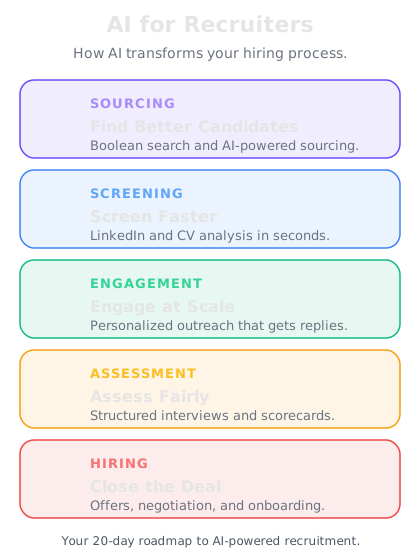
Over the next 20 days, you're going to build an AI-powered recruitment system that transforms every stage of the hiring process. No technical background needed. Just practical, step-by-step lessons designed for recruiters who'd rather be talking to candidates than formatting spreadsheets.
Week 1 — Foundations & Sourcing: Set up your AI tools, write job descriptions that attract, master boolean search with AI, learn to read LinkedIn profiles in 30 seconds, and screen CVs at scale.
Week 2 — Engagement & Assessment: Write outreach that gets replies, solve the scheduling nightmare, generate interview questions and scorecards, compare candidates against job specs instantly, and build a complete assessment pipeline.
Week 3 — Brand, Scale & Build: Create employer branding content, master recruitment marketing, handle offers and negotiation, build a LinkedIn summariser Chrome extension, and set up onboarding plans with AI.
By Day 20, you'll have a complete system that makes you faster, more consistent, and more effective than any recruiter working without AI.