Your Career Launchpad
Day 28. You made it.
Four weeks ago, you started this course wondering if AI could actually help you land a better job. Today you have the answer — and the proof is in everything you've built along the way.
This isn't a graduation where you forget everything by next Monday. This is a launch pad. Let's look at how far you've come, and where you go from here.
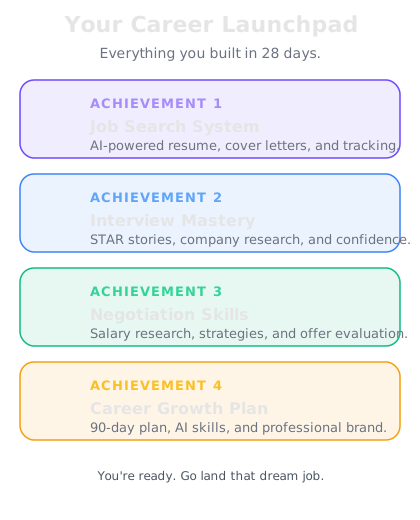
What you accomplished in 28 days
Let's rewind and see the full picture:
Week 1: Foundations. You discovered your real value with an AI skills assessment. You set up your toolkit. You found your target role using market research. You decoded job descriptions. You built a career narrative that makes interviewers lean in. You went from "I don't know what I'm looking for" to "I know exactly what I'm worth and where I fit."
Week 2: Materials. You built an ATS-optimized resume, a cover letter system that produces personalized letters in 5 minutes, a LinkedIn profile that attracts recruiters, a content strategy that positions you as an expert, and a portfolio of case studies. You went from a generic resume to a complete personal marketing machine.
Week 3: Offense. You learned to research companies in 10 minutes, write networking messages that get replies, find hidden jobs, master interview questions, prepare behavioral stories using STAR, and handle technical interviews with frameworks. You went from hoping for callbacks to engineering them.
Week 4: Close and launch. You researched salaries, learned negotiation scripts, built a decision framework, created a 90-day plan, and built a long-term career brand. You went from "I hope they make me an offer" to "I'm negotiating from a position of strength."
That's not theory. That's 28 days of building real skills and real tools.
Where you stand now
Here's what you can do that most job seekers can't:
You can tailor a resume in 10 minutes that would take an hour manually — and it beats ATS every time.
You can write a cover letter in 3 minutes that reads like you spent 30 minutes researching the company.
You can research any company in 10 minutes — deeply enough to impress interviewers who've worked there for years.
You can prepare for any interview in 60 minutes — common questions, behavioral stories, technical frameworks, and smart questions to ask.
You can negotiate with confidence — backed by market data, clear scripts, and a collaborative approach.
You can find jobs that aren't posted — by monitoring growth signals, building relationships, and reaching out proactively.
These aren't temporary skills. This is a career system you'll use for every job move you make for the rest of your life.
The career advantage is real — and it's yours
Here's the reality: AI is changing every industry, every role, and every career. The people who understand how to use it effectively have an advantage that grows every year.
You didn't just learn how to use AI for job hunting. You learned how to use AI as a career multiplier. The research skills, the writing skills, the analysis skills, the preparation habits — these transfer to everything you do professionally.
In your job search: You compete at a level most candidates can't match.
In your new role: You ramp faster, produce more, and get promoted sooner.
For the rest of your career: You have a system that makes every move strategic, prepared, and confident.
The job market will always be competitive. But you're no longer competing on a level playing field. You've built tools, skills, and habits that give you an unfair advantage — and that advantage compounds with every month you practice.
Keep building. Keep learning. Keep showing up.
The people who do the best with AI aren't the ones who learned the most — they're the ones who kept going after the course ended.
That's you. Starting now.