Day 23 of 28 · AI Job Hunt
Negotiation Scripts and Strategies
⏱ 6 min
📊 Beginner
You got the offer. Congratulations — that's a huge deal and you should feel good about it. But the work isn't done. The difference between a good offer and a great one is usually a single conversation.
Most people accept the first number because negotiation feels uncomfortable. Today, you'll learn that negotiation isn't confrontational — it's collaborative. And AI gives you the exact words to use.
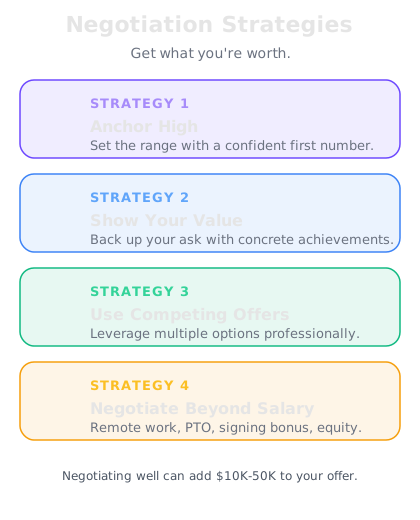
Get what you're worth with AI-powered negotiation scripts.
Why you should always negotiate
Here's what most people don't know: 84% of employers expect candidates to negotiate. When you don't, you're not being polite — you're leaving money on the table that was already budgeted for you.
Hiring managers have a range. The initial offer is almost never the top of that range. It's typically the midpoint or lower. Your job is to find out how much room exists.
And here's the reassuring part: no company has ever rescinded an offer because someone negotiated professionally. Ever. The worst case scenario is they say "this is our best offer." That's it.
Knowledge Check
What percentage of employers expect candidates to negotiate their initial offer?
D
About 84% — most employers build negotiation room into their initial offers
Companies budget for negotiation. The initial offer has room built in — for base salary, signing bonus, equity, or benefits. When you accept without negotiating, you're not saving them money (they already budgeted it). You're just leaving your money with them.
The negotiation framework
Follow this sequence and you'll handle any offer conversation with confidence:
Step 1: Express enthusiasm. Always start positive. "Thank you so much — I'm really excited about this opportunity. The team, the role, and the company are exactly what I've been looking for."
Step 2: Ask for time. "I'd like to take a couple of days to review the full package. Is that okay?" This is always reasonable and buys you time to strategize.
Step 3: Research and prepare. Use AI to analyze the offer, compare it to market data, and draft your counter.
Step 4: Make your ask. Be specific, be reasonable, and frame it as collaborative — not adversarial.
Step 5: Be prepared to meet in the middle. Know your walk-away number in advance.
I just received an offer for $135K base, 10% bonus, and 5,000 RSUs vesting over 4 years. Based on my research, I should be at $145-155K base. Help me write a negotiation script that's confident but collaborative.
Here's your script:
**Opening (by phone or video — never negotiate over email for the first round):**
"Thanks again for the offer — I'm genuinely excited about joining the team. I've had a chance to review the full package, and I want to have an honest conversation about compensation."
**The ask:**
"Based on my research into market rates for this role — factoring in my 5 years of experience, the product launch results I bring, and the cost of living in this market — I was hoping we could get closer to $150K on the base. I've seen ranges of $140-160K for comparable roles at similar-stage companies, and I believe $150K reflects both my experience and the scope of this position."
**If they push back:**
"I understand there may be constraints on the base. Would it be possible to bridge the gap in other ways — perhaps a higher signing bonus, additional equity, or an accelerated review cycle at 6 months instead of 12?"
**If they say this is their best offer:**
"I appreciate the transparency. Can I ask — is there flexibility on the signing bonus or equity side? Even a one-time signing bonus of $10-15K would help bridge the difference."
**Closing:**
"I want to make this work — this is my top choice. I just want to make sure we start the relationship on the right foot for both of us."
---
**Key principles in this script:**
- Always express enthusiasm first
- Anchor to market data, not personal needs
- Give a specific number (not "more money")
- Offer alternatives if base is firm
- Frame as collaborative ("make this work for both of us")
↻ Replay conversation
Knowledge Check
What should you do if a company says they can't increase the base salary?
A
Threaten to take another offer
C
Ask about other levers — signing bonus, additional equity, accelerated review cycle, extra PTO, or professional development budget
Compensation has many levers beyond base salary. A $15K signing bonus, 2,000 additional RSUs, or a guaranteed 6-month review with potential for a raise can all make up for a lower base. Companies often have more flexibility on these items than on base salary, because they're one-time costs or have different budget categories.
Negotiating without another offer
The strongest negotiation position is having a competing offer. But you can negotiate effectively without one.
Leverage without competing offers:
Your research. "Market data shows this role ranges from $140-160K at comparable companies."
Your results. "My track record includes $X in revenue impact, Y% improvement in metrics — I want the compensation to reflect that value."
Your walk-away clarity. You don't need to say it out loud, but knowing your minimum number gives you confidence. If the offer doesn't meet your floor, you can walk.
Your enthusiasm. Ironically, genuine excitement about the role is leverage. Companies invest heavily in recruiting — they don't want to lose their top candidate over $10K when the recruiting process cost them $20K.
Knowledge Check
Can you negotiate effectively without a competing offer?
A
Only if you're willing to walk away
B
No — you need a competing offer to negotiate
D
Yes — market data, your proven results, and genuine enthusiasm for the role all provide leverage even without a competing offer
While competing offers strengthen your position, they're not required. Market data ("this role pays $140-160K at comparable companies"), your quantified results, and even your genuine enthusiasm are all forms of leverage. Companies would rather pay $10K more than restart a search that costs $20K+ in recruiter fees and lost time.
What NOT to do when negotiating
Don't negotiate over email (for the first round). Tone is lost in text. A phone call lets you read the room and adjust.
Don't give an ultimatum. "Give me $150K or I walk" burns bridges. Always frame collaboratively.
Don't lie about competing offers. If they call your bluff, you've destroyed trust. Only reference real offers.
Don't apologize. "I'm sorry to ask, but..." undermines your position. You're not asking for a favor — you're having a business conversation about fair market value.
Don't negotiate on the spot. Always ask for time to review. Pressure to decide immediately is a tactic — and you don't have to accept it.
Final Check
What's the most important thing to remember about salary negotiation?
A
Never negotiate — it makes you look greedy
B
Only negotiate if the offer is insultingly low
C
Always ask for 50% more than the offer
D
Negotiation is a normal, expected part of the hiring process — companies budget for it, and doing it professionally and collaboratively almost always results in a better outcome
Negotiation is expected. Companies build room into offers specifically because they expect you to negotiate. Doing it professionally — with data, enthusiasm, and a collaborative tone — almost always results in more money. It also signals that you're someone who knows their value and advocates for themselves — both traits companies respect.
🤝
Day 23 Complete
"They already want you. The negotiation isn't about convincing them to hire you — it's about agreeing on a number that reflects your value. You have more power than you think."
Tomorrow — Day 24
Evaluating Offers
Tomorrow you'll build a decision framework for when multiple offers compete for your attention.