Day 12 of 28 · AI Job Hunt
LinkedIn Content That Attracts Recruiters
⏱ 5 min
📊 Beginner
There are two ways to get hired: you go find jobs, or jobs find you. LinkedIn content makes jobs find you.
When you post consistently about your expertise, recruiters notice. Hiring managers notice. People in your network think of you when they hear about openings. You stop being one of 500 applicants and start being the person who already showed up in their feed.
Today, you'll learn to create LinkedIn content that positions you as a hire-worthy expert — using AI to do it in minutes.
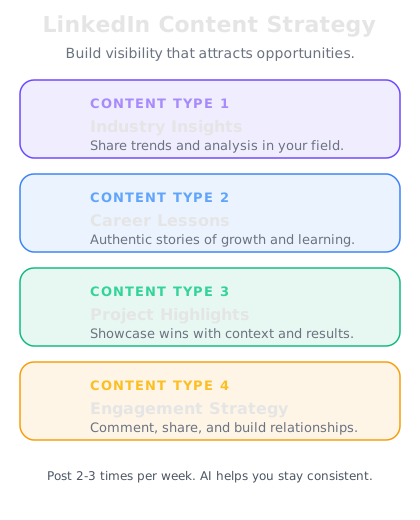
Build visibility that attracts opportunities to you.
Why posting on LinkedIn works for job seekers
Here's the math: the average LinkedIn post gets shown to 5-10% of your connections. If you have 500 connections, that's 25-50 people seeing your content per post. Post 3 times per week, and that's 75-150 impressions per week — from people in your industry.
Now imagine those impressions are posts about your expertise, your insights, and your professional perspective. You're not job hunting — you're demonstrating competence in public. That's the most powerful form of marketing.
Hiring managers have told us: "When I see someone consistently sharing smart takes about product marketing, and then their resume lands on my desk, they're already ahead of every other candidate."
Knowledge Check
What's the main benefit of posting LinkedIn content during a job search?
A
It increases your follower count
B
LinkedIn promotes profiles of active posters
C
It demonstrates your expertise publicly — so when your resume lands on a hiring manager's desk, they already see you as a credible expert
D
It makes your profile look active
Content transforms you from an unknown applicant into a recognized voice. When a hiring manager has already seen your smart takes on their feed, your application gets moved to the top of the pile. You've pre-sold yourself before the interview even starts.
Content ideas for job seekers
You don't need to be a thought leader or a content guru. You just need to share what you know. Here are the formats that work best:
The "Here's what I learned" post. Share a lesson from your career. "3 years in customer success taught me that the best way to prevent churn is..." This shows expertise without bragging.
The "How I'd approach this" post. Take a real industry challenge and break down your approach. "If I were launching a product in a crowded market, here's my 5-step playbook..." This shows strategic thinking.
The "Unpopular opinion" post. Challenge conventional wisdom in your field. "Most companies waste money on brand awareness campaigns when they should be investing in..." This shows independent thinking.
The "Celebrating others" post. Highlight something a colleague, company, or tool did well. This shows you're generous and well-connected.
I'm a marketing manager looking for a Product Marketing Manager role. Write me 3 LinkedIn posts I can use this week. Each should be under 150 words, show my expertise in product launches, and feel authentic — not salesy. I want to attract recruiters without explicitly saying I'm job hunting.
**Post 1 — "The Launch Lesson"**
The biggest product launch mistake I see companies make:
Building the product → creating the messaging → telling sales.
What actually works:
Understanding the customer problem → creating the messaging → building the product to match → arming sales before a single feature ships.
When we flipped this order on our last launch, feature adoption hit 28% in the first quarter — 3x our previous launches.
Product marketing isn't about describing what you built. It's about making sure you built the right thing, for the right person, with the right story.
The messaging should drive the product. Not the other way around.
---
**Post 2 — "The Content Engine"**
A year ago, content drove 15% of our inbound leads.
Today it drives 45%.
Here's what changed (it wasn't budget):
→ We stopped writing about what WE wanted to say
→ We started writing about what our buyers were searching for
→ We built a content-to-demo pipeline (blog → gated guide → nurture → demo)
→ We measured content by pipeline generated, not page views
The shift from "content marketing" to "content that markets" sounds subtle. The revenue impact isn't.
---
**Post 3 — "The Cross-Functional Play"**
The most underrated skill in product marketing:
Getting sales, product, and CS in a room and leaving with alignment — not just agreement.
Agreement is "sure, sounds good" in the meeting and doing their own thing after.
Alignment is everyone understanding the customer, the positioning, and their role in the launch.
I've found one question that forces alignment every time:
"If a customer asks 'why should I care about this?' — what does each of us say?"
If the answers are different, you're not ready to launch.
↻ Replay conversation
Knowledge Check
Why do these posts work for a job search without explicitly saying "I'm looking for a job"?
A
Because LinkedIn hides posts from people who are "Open to Work"
B
Because they demonstrate expertise through real examples and specific results — which makes hiring managers and recruiters seek you out naturally
C
Because they're vague enough that no one knows the real intent
D
Because job-hunting posts get penalized by the algorithm
Show, don't tell. A post about how you grew content-driven leads from 15% to 45% does more for your job search than any "I'm open to opportunities" banner. Hiring managers want to hire people who are already thinking and doing at a high level — and your content proves that.
The weekly posting system
Keep it simple: 3 posts per week. Use AI to draft them in one sitting.
Monday: A lesson or insight from your work experience.
Wednesday: A take on an industry trend or challenge.
Friday: A personal reflection on career growth, leadership, or working style.
Prompt for AI: "Write a LinkedIn post about [topic] from my perspective as a [your role]. Keep it under 150 words, use short paragraphs, and end with an insight or question. Tone: confident but not arrogant, practical, authentic."
Draft all 3 on Sunday evening. Schedule them. Done in 15 minutes.
Final Check
How often should you post on LinkedIn during your job search?
A
2-3 times per week — enough to build consistent visibility without burning out or running out of ideas
B
Every day for maximum visibility
C
Only when you have something truly groundbreaking to say
Consistency beats virality. Three posts a week builds a steady drumbeat of visibility. You don't need every post to go viral — you need the right 50-100 people (recruiters, hiring managers, peers) to see you regularly. That compounds over 4-6 weeks into real opportunity.
📢
Day 12 Complete
"The best job seekers don't just apply — they show up. LinkedIn content turns you from applicant #347 into 'that person who posts the smart stuff.'"
Tomorrow — Day 13
Building a Portfolio with AI
Tomorrow you'll create case studies and work samples that prove your value — even without a traditional portfolio.