Day 9 of 28 · AI Job Hunt
Beating Applicant Tracking Systems
⏱ 5 min
📊 Beginner
Here's the uncomfortable truth: the biggest obstacle between you and an interview isn't a human being — it's a robot.
Applicant Tracking Systems (ATS) are the gatekeepers. Companies like Greenhouse, Lever, Workday, and Taleo scan your resume before a recruiter ever sees it. If your resume doesn't match what the ATS is looking for, you're rejected in milliseconds.
Today you'll learn exactly how ATS works — and how AI helps you beat it every time.
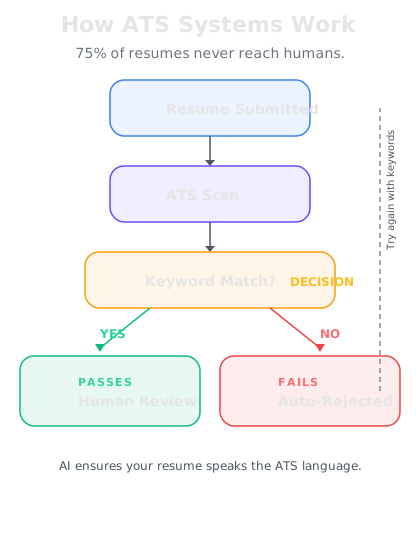
75% of resumes are rejected before a human ever sees them.
How ATS actually works
ATS does three things:
1. Keyword matching. It scans your resume for specific words and phrases from the job description. If the JD says "project management" and your resume says "managing projects," some ATS systems won't count it as a match.
2. Formatting parsing. ATS extracts text from your resume and tries to understand its structure — name, contact info, experience, education. If your formatting is fancy (tables, columns, graphics), ATS can mangle or miss entire sections.
3. Scoring and ranking. Based on keyword matches and other criteria, ATS assigns your resume a score. Recruiters typically only see the top-scoring resumes.
The result: even qualified candidates get filtered out because of formatting issues or missing keywords. It's not fair, but it's reality.
Knowledge Check
What's the most common reason qualified candidates get rejected by ATS?
A
Their resume is missing keywords from the job description or uses formatting that ATS can't parse correctly
C
Their resume is too long
D
They don't have enough experience
ATS rejection is almost always a technical problem, not a qualifications problem. Missing keywords (or using synonyms instead of exact terms) and unreadable formatting are the top two killers. Both are completely fixable with AI.
The ATS-proof resume format
Here's what ATS can and can't read:
Use:
- Simple, clean formatting with clear section headers
- Standard section names: "Experience," "Education," "Skills" (not "My Journey" or "What I Bring")
- Standard fonts (Arial, Calibri, Times New Roman)
- .docx or .pdf format (check what the application asks for)
- Bullet points (simple dashes or dots)
- Consistent date formatting (Month Year – Month Year)
Avoid:
- Tables, columns, or text boxes (ATS often can't read them)
- Headers and footers (many ATS skip these entirely)
- Images, icons, or graphics
- Unusual characters or symbols
- Embedded charts or infographics
I have a fancy resume with two columns, icons for my skills, and a sidebar for my contact info. Is this going to cause problems with ATS?
Almost certainly, yes. Here's what's likely happening:
**Two-column layout:** ATS often reads left-to-right across both columns, scrambling your content. Your work experience might get mixed with your skills section.
**Icons:** ATS ignores images entirely. If your skills are represented by icons (like star ratings or progress bars), ATS sees nothing.
**Sidebar contact info:** Many ATS systems skip sidebars or text boxes. Your phone number and email might not get parsed at all.
**The fix:** Use a single-column layout with standard section headers. Put your contact info at the top of the main content area. List skills as plain text.
I know it feels like a downgrade visually, but remember: the first reader isn't human. Your goal is to get past the ATS to a human — and then your content does the selling.
Want me to convert your fancy resume into an ATS-friendly format?
↻ Replay conversation
The AI keyword optimization technique
Here's the most powerful ATS hack: let AI do a side-by-side comparison of the job description and your resume, then fill in the gaps.
Here's the job description for the role I'm applying to: [paste JD]. And here's my current resume: [paste resume]. Compare the two and tell me: 1) What keywords from the JD am I missing? 2) What keywords do I have that match? 3) What specific changes should I make to improve my ATS score?
**Keywords you already have (good):**
✅ Project management, cross-functional, data analysis, stakeholder management, Salesforce
**Keywords you're missing (critical):**
❌ "Agile methodology" — JD mentions it twice, you don't mention it at all
❌ "OKRs" — JD specifically mentions OKR framework
❌ "Roadmap" — used 3 times in JD ("product roadmap," "strategic roadmap")
❌ "Go-to-market" — central to the role description
❌ "Revenue impact" — they want someone who thinks in revenue terms
**Recommended changes:**
1. Add "Led projects using Agile methodology" to your experience (if true)
2. Change "set team goals" to "defined and tracked OKRs for a team of 6"
3. Add "product roadmap" to a bullet: "Contributed to product roadmap planning..."
4. Include "go-to-market" in your launch-related bullets
5. Reframe at least one bullet around revenue: "Drove initiatives contributing to $X in revenue"
**Estimated ATS score improvement:** from ~55% match to ~85% match with these changes.
↻ Replay conversation
Knowledge Check
What should you do if a job description uses a keyword you have experience with but didn't include on your resume?
A
Add it naturally into your experience bullets using their exact phrasing — ATS scans the full resume, not just the skills section
B
Ignore it — they'll figure it out in the interview
C
Put all missing keywords in a hidden white-text section
D
Add it only to your skills section
Weave missing keywords naturally into your experience bullets. ATS scans your entire resume, so "Led cross-functional projects using Agile methodology" is better than just adding "Agile" to a skills list. And never use hidden text tricks — ATS can detect them, and it's an instant rejection.
The 5-minute ATS check
Before you submit any application, run this quick check:
Step 1: Paste your resume and the JD into AI. Ask for a keyword match percentage.
Step 2: Fix any gaps by weaving missing keywords into existing bullets (don't add skills you don't have).
Step 3: Check formatting — single column, standard headers, no tables or graphics.
Step 4: If possible, submit as .docx (ATS parses Word files more reliably than PDFs in some systems).
This 5-minute routine is the difference between your resume reaching a human or disappearing into a digital black hole.
Final Check
Why should you never add skills you don't actually have to pass ATS?
A
Because ATS can detect lies
B
Because recruiters don't check skills
C
Because extra keywords actually lower your ATS score
D
Because even if ATS passes you through, you'll be exposed in the interview — and getting caught lying about skills is an instant rejection and reputation killer
ATS is just the first gate. If you claim "Agile methodology" and can't discuss it in an interview, you've wasted everyone's time and burned a bridge. The goal is to surface real skills using the right language — not to fabricate them.
🤖
Day 9 Complete
"ATS doesn't care about your potential. It cares about keywords and formatting. Give it what it wants, and a human gets to see how good you really are."
Tomorrow — Day 10
Cover Letters That Actually Get Read
Tomorrow you'll learn to write cover letters that hiring managers want to read — in under 5 minutes.