Day 15 of 28 · AI Job Hunt
AI-Powered Company Research
⏱ 5 min
📊 Beginner
Week 3 begins. You have the materials — now it's time to go on offense. And the most powerful weapon in your arsenal isn't your resume. It's knowing more about the company than any other candidate in the room.
Today, you'll learn to research any company in 10 minutes — deeply enough to impress interviewers, write targeted applications, and make networking conversations genuinely valuable.
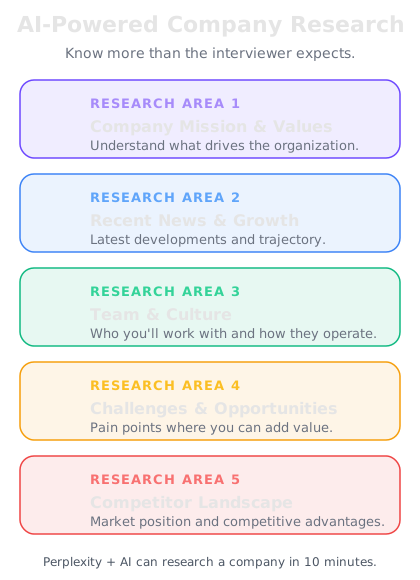
Know more about the company than any other candidate.
What most candidates research vs. what you should research
Most candidates: Read the "About Us" page. Maybe skim the CEO's LinkedIn. Walk into the interview knowing the company's tagline and not much else.
You, after today: Know their recent product launches, their competitive challenges, their growth trajectory, their culture (from real employee reviews), their leadership team's priorities, and 2-3 specific ways you could add value.
That gap is enormous. And it takes the same amount of time — because AI does the heavy lifting.
I have an interview at Figma next week for a Product Marketing Manager role. Give me a comprehensive research brief: what does Figma do, what's their competitive landscape, recent news, company culture, likely challenges, and what they'd want from this hire. I want to walk in better prepared than any other candidate.
**Figma — Research Brief**
**What they do:** Collaborative design platform used by product teams for UI/UX design, prototyping, and design systems. Known for being browser-based (no downloads) and multiplayer (real-time collaboration).
**Business context:**
- Was acquired by Adobe for $20B (later abandoned due to regulatory concerns)
- Returned to independence with massive market validation
- Expanding beyond designers: FigJam (whiteboarding), Dev Mode (developer handoff), AI features
**Competitive landscape:**
- Sketch: Legacy player, losing market share
- Adobe XD: Effectively dead after failed acquisition
- Canva: Encroaching from the simpler end
- New AI-native design tools emerging
**Likely challenges:**
- Expanding beyond designers to reach PMs, developers, and marketers
- Monetizing AI features without alienating creative community
- Competing with free/cheap alternatives for smaller teams
- Telling a product story that resonates with non-designers
**Culture signals (from employee reviews and public signals):**
- Collaborative and design-driven (they eat their own cooking)
- Values craft and attention to detail
- Startup energy despite scale
- Strong engineering and design culture — marketing needs to earn credibility
**What they want from this hire:**
- Someone who can translate technical product features into market narratives
- Experience marketing to product teams (designers, PMs, engineers)
- Ability to position AI features authentically
- Cross-functional collaboration with product and engineering
**Your cheat codes for the interview:**
1. Reference FigJam or Dev Mode specifically — shows you know beyond the core product
2. Have an opinion on how to market AI features to designers who are skeptical of AI
3. Show awareness of the post-Adobe landscape and what independence means for their brand
4. Reference specific Figma community initiatives (Config conference, community files)
↻ Replay conversation
Knowledge Check
What makes this research brief more useful than reading the company's website?
B
It's longer and more detailed
C
It includes employee gossip
D
It covers competitive context, likely challenges, and specific insights that help you connect your experience to their actual needs — information the website deliberately hides
A company's website tells you what they want you to know. AI-powered research tells you what you need to know — competitive pressures, internal challenges, and the real reason they're hiring. That's the information that makes you stand out in an interview.
The 10-minute research protocol
For every company you're serious about, run this 10-minute protocol:
Minutes 1-3: The overview. Ask AI for a company brief — what they do, their market position, recent news, and business model.
Minutes 4-6: The challenges. Ask: "What are the biggest challenges [Company] is likely facing right now? What problems might this hire be expected to solve?"
Minutes 7-8: The culture. Ask AI to summarize Glassdoor reviews and cultural signals. What do employees love? What are common complaints?
Minutes 9-10: The connection. Ask: "Based on this research and my background [paste summary], what are 3 specific ways I could add value to this company?"
Save these notes. You'll use them for your application, networking messages, and interview prep.
Knowledge Check
Why should you research a company's challenges before applying?
A
To find reasons not to apply
B
To negotiate a higher salary from the start
C
So you can decide if you want to work there
D
So you can position yourself as the solution to their specific problems — in your resume, cover letter, and interview
When you understand a company's challenges, you stop being a generic candidate and start being a targeted solution. "I can do product marketing" is forgettable. "I see you're expanding beyond designers — I've spent 3 years marketing technical products to non-technical audiences, and here's how I'd approach it" is unforgettable.
Researching the people you'll meet
The research doesn't stop at the company level. Before any interview or networking conversation, research the individual:
"I'm meeting [Name], [Title] at [Company], for an interview. Based on their LinkedIn profile and public information, what can you tell me about their background, interests, and likely priorities? What questions might they focus on, and how can I connect with them?"
This takes 2 minutes and gives you a massive advantage. When you reference their background or recent work naturally in conversation — "I saw your talk at [Conference] and really liked your point about..." — you immediately build rapport.
Final Check
What's the most valuable thing to learn about an interviewer before meeting them?
A
Their social media activity
B
Their professional background and likely priorities — so you can frame your experience in terms of what matters most to them
C
How long they've been at the company
Understanding what an interviewer cares about lets you frame your answers in their language. If the VP of Sales is interviewing you, emphasize revenue impact. If the Head of Product is interviewing, emphasize cross-functional collaboration and customer insights. Same experience, different framing — and AI helps you prepare that framing in minutes.
🔬
Day 15 Complete
"The best-prepared candidate wins. And with AI, being the best-prepared candidate takes 10 minutes, not 10 hours."
Tomorrow — Day 16
Networking Messages That Get Replies
Tomorrow you'll write outreach messages that make people want to help you.