SEO Titles & Keywords That Rank
Yesterday you learned to generate product descriptions at scale. Today you make sure people actually find them.
The best product description in the world is worthless if it doesn't appear in search results. Whether your customers are searching on Amazon, Etsy, Google, or your Shopify store's search bar, the right keywords in the right places determine whether your product gets seen or gets buried on page 47.
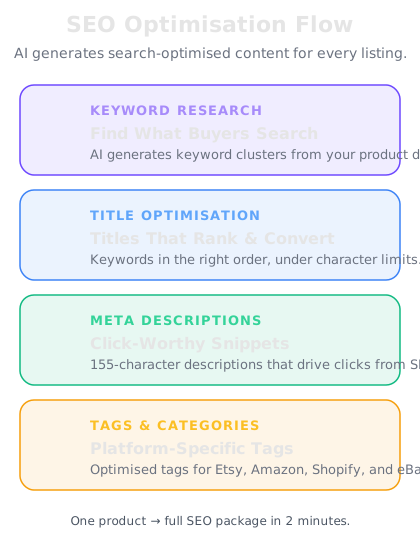
AI is exceptional at keyword research and SEO optimization. It can generate hundreds of keyword variations, structure titles for each platform's algorithm, and write meta descriptions that get clicks. Today you'll learn how.
How e-commerce search actually works
Before we optimize, let's understand what we're optimizing for. Every platform has its own search algorithm, but they all share the same basic logic:
The customer types words. "Wireless earbuds for running" or "handmade leather journal" or "kids rain boots size 10."
The algorithm matches those words to product listings that contain them — in titles, descriptions, bullet points, tags, and backend keywords.
The algorithm ranks the matches based on relevance, conversion history, reviews, and other signals.
Your job is simple: make sure the words your customers type appear in your listing, in the right places, with the right structure. AI helps you do this systematically instead of guessing.
AI-powered keyword research
Here's where AI transforms your SEO workflow. Instead of manually brainstorming keywords or paying for expensive tools, you can generate comprehensive keyword lists in minutes.
Seed keyword expansion — Give AI your main product keyword, and it generates dozens of variations. "Leather wallet" becomes: "men's leather wallet," "slim leather wallet," "RFID blocking leather wallet," "handmade leather bifold wallet," "genuine leather card holder," and dozens more.
Long-tail keywords — These are the specific, multi-word phrases that have less competition but high purchase intent. "Wallet" is a short-tail keyword that's almost impossible to rank for. "Slim RFID blocking leather wallet for front pocket" is a long-tail keyword where you can actually compete. AI generates these by the dozen.
Customer language vs. seller language — This is a subtle but critical distinction. You might call your product a "ceramic pour-over coffee dripper." Your customers might search for "coffee maker" or "manual coffee brewer" or "pour over cone." AI helps you bridge this gap by generating keywords from the customer's perspective.
Competitor keyword analysis — Use Perplexity to research what top sellers in your category include in their titles and descriptions. Then feed those insights to ChatGPT: "Here are the keywords my top 5 competitors use. Generate a comprehensive keyword list that covers what they're targeting plus gaps they're missing."
Platform-specific title formulas
Each platform has its own rules for titles. Here's how to structure them:
Amazon titles follow a specific formula for maximum A9 search visibility:
Brand + Product Type + Key Feature + Material + Size/Quantity + Color
Example: "RidgeLine Men's Slim Leather Wallet - RFID Blocking Bifold with 12 Card Slots - Full Grain Italian Leather - Dark Brown"
Amazon allows up to 200 characters. Use them wisely — front-load the most important keywords. AI can generate 10 title variations that follow this structure so you can pick the best one.
Etsy titles can be up to 140 characters. Etsy's search algorithm heavily weighs the first few words. Put your most important keyword first.
Example: "Leather Wallet Mens, Slim Bifold RFID Blocking Wallet, Handmade Italian Leather Card Holder, Gift for Him"
Notice the comma-separated structure — this is an Etsy convention that helps you pack in multiple keyword phrases.
Shopify / Google Shopping titles should be clean, readable, and keyword-rich. Google's algorithm favors natural language over keyword stuffing.
Example: "Men's Slim Leather Bifold Wallet with RFID Blocking - Italian Leather"
eBay titles max out at 80 characters. Every character counts. Lead with the most-searched terms and skip articles like "the" and "a."
Example: "Mens Slim Leather Wallet RFID Blocking Bifold Italian Leather 12 Card Slots"
Meta descriptions and Google Shopping
If you sell through your own Shopify or WooCommerce store, you're not just optimizing for on-platform search — you're also competing in Google Shopping and organic Google results.
Meta descriptions are the short text snippets that appear under your page title in Google search results. They don't directly affect ranking, but they dramatically affect whether someone clicks your listing versus a competitor's.
AI writes excellent meta descriptions when you give it the right prompt:
"Write a 155-character meta description for [product name] that includes [primary keyword], highlights [key benefit], and ends with a reason to click."
Example output: "PeakHydro 32oz insulated water bottle keeps drinks ice-cold for 24 hours. Leak-proof, BPA-free stainless steel. Free shipping on orders over $30."
Google Shopping feed optimization — If you run Google Shopping ads, your product titles and descriptions in your data feed determine which searches trigger your ads. The same keyword research you've done today applies directly. Use AI to create Google Shopping-specific titles that are concise, keyword-rich, and descriptive.
The keyword integration workflow
Here's your step-by-step process for optimizing any listing:
Step 1 — Generate keywords. Use ChatGPT to create 30-50 keyword variations for your product. Include short-tail, long-tail, and customer-language variations.
Step 2 — Prioritize. Use Perplexity to research which keywords your top competitors are targeting. Cross-reference with your AI-generated list. The sweet spot is keywords with decent search volume that your competitors aren't fully covering.
Step 3 — Write the title. Use the platform-specific formula. Front-load your top 2-3 keywords. Let AI generate 5-10 title options.
Step 4 — Integrate into descriptions. Take the product descriptions you wrote yesterday and ask AI: "Naturally integrate these keywords into the description without making it sound stuffed or unnatural: [keyword list]."
Step 5 — Fill backend fields. Amazon has backend search terms. Shopify has meta fields. Etsy has 13 tags. Use your remaining keywords here — these are invisible to customers but visible to search algorithms.
Avoiding keyword stuffing
There's an important line between optimization and spam. Search algorithms are smart enough to detect — and penalize — keyword stuffing.
What keyword stuffing looks like: "This leather wallet is the best leather wallet for men who want a leather wallet that is a slim leather wallet made of real leather for wallet lovers."
What natural optimization looks like: "Crafted from full-grain Italian leather, this slim bifold wallet fits comfortably in your front pocket. With 12 card slots and RFID-blocking technology, it keeps your essentials organized and your information secure."
Both versions target the same keywords. One reads like spam. The other reads like a compelling description that happens to contain the right keywords. AI naturally writes like the second example when you prompt it correctly.
The rule is simple: write for humans first, algorithms second. If a description sounds awkward when you read it out loud, the keywords aren't integrated well. Ask AI to "rewrite this so the keywords sound natural" and it will fix it instantly.